By Karen Svold Coates, M.Sc. Biology · First-hand: two DB-booked journeys with our dog, spring 2026 · Last updated June 2026
Taking a Dog on German Trains: Deutsche Bahn’s Confusing Rules, Explained First-Hand (2026)
Deutsche Bahn’s dog rules are some of the most confusing in Europe — free for small dogs but not big ones, half-price tickets on some journeys and full-price on others, a booking system where a paid dog is entered as “Hund,” and a muzzle rule everyone asks about. We travelled through Germany with Sofus, our 6.2 kg Coton de Tuléar, on two trains booked at bahn.de — the EuroCity from Poznań to Berlin and the ComfortJet from Berlin towards Denmark — and in both cases the reality was far simpler than the rulebook: the dog travelled free, listed on the ticket, and nobody ever checked a muzzle. Here are the official rules untangled, and what actually happened.
The small-dog rule: free, and simple
A small dog — up to roughly the size of a house cat — travels free on Deutsche Bahn, officially in a closed carrier. On both our bahn.de bookings, Sofus was added to the ticket at no charge.
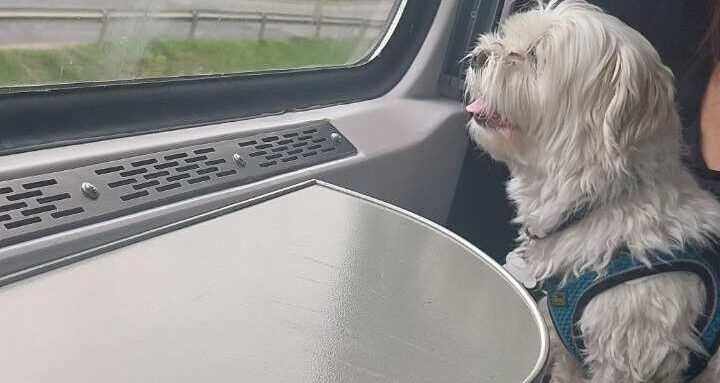
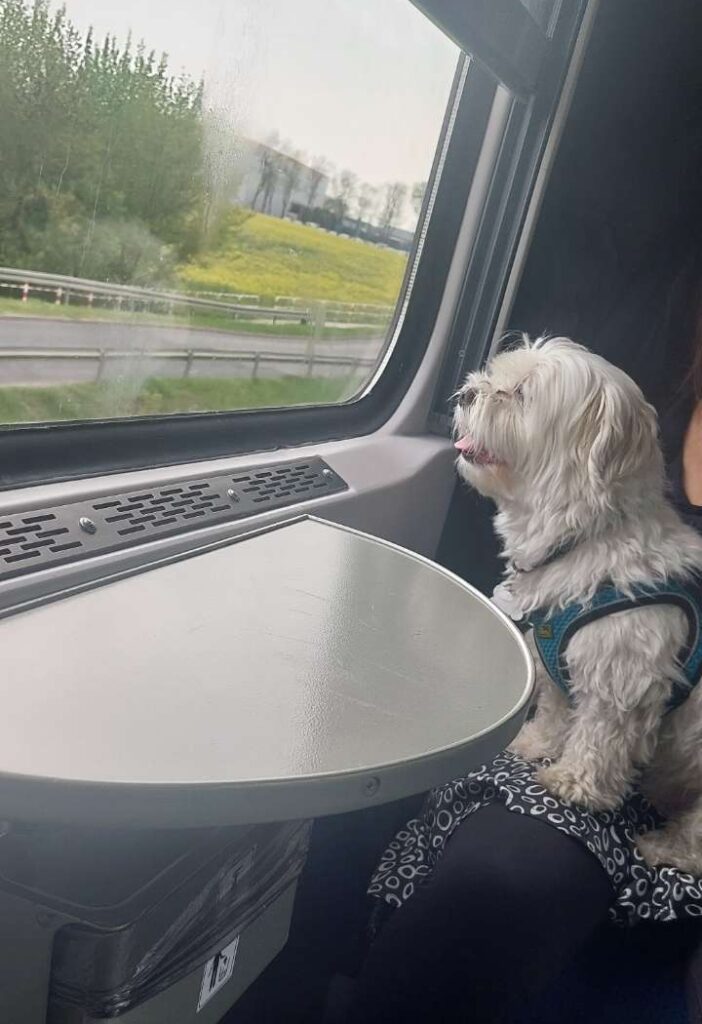
This is the good news, and if your dog is small it’s most of what you need to know. When we booked at bahn.de, the dog was simply part of the booking — on the ComfortJet ticket he appeared as “1 Hund,” fare: nothing. The official framing is that small dogs travel free in a carrier; the practical reality on our journeys was that Sofus spent most of the time out of the bag, on the floor or a lap, and no conductor on either train raised an eyebrow. Bring the carrier — it’s your fallback if a conductor insists or a neighbour objects — but expect a relaxed reality.
The big-dog rules: where it gets genuinely strange
A dog larger than a cat needs a ticket: half-price on long-distance trains, but full adult price on many regional services, and a child’s ticket on cross-border journeys. Paid dog tickets often can’t be issued as mobile e-tickets.
This is the part that fills forums with confusion, so here it is untangled. A larger dog (anything bigger than a house cat) pays: on long-distance ICE/IC/EC journeys the dog ticket is half the adult fare; on regional journeys it can be a full adult fare; on cross-border journeys the dog is booked with a child’s ticket. Stranger still, when booking online, a paid dog is entered with “Hund” in place of a passenger name — and DB has historically not issued mobile e-tickets for dogs, meaning tickets by post or from the station. It’s a system only a large bureaucracy could design. If you’re travelling with a big dog, our honest advice: book early, at a station or with time for postal delivery, and confirm the current process on bahn.de — it changes, and it’s the least transparent part of German dog travel.
Two universal rules regardless of size: dogs travel on the floor, never on seats, and there are no seat reservations for dogs.
What our journeys were actually like
Two DB-booked trains through Germany: an empty six-seat compartment on the EuroCity from Poznań, and a calm half-empty ComfortJet from Berlin. Both times: dog free, out of the bag, completely uneventful.
The EuroCity EC 46 from Poznań to Berlin Hauptbahnhof was, in the end, the easiest border we ever crossed. We’d booked four seats of a six-seat compartment at bahn.de and had the whole compartment to ourselves; a steward brought free juice and water and — with real kindness — kept his distance so as not to unsettle the small dog. At the Polish–German border, police walked the train and checked nothing: not our passports, not Sofus’s. The most-prepared-for moment of the trip passed us by entirely. Have the EU pet passport ready; expect not to need it.
The ComfortJet from Berlin (our leg home towards Denmark) told the same story: dog printed on the ticket as “1 Hund,” free, two conductors — one German, one Danish — glancing at Sofus and asking nothing. We’ve written up that whole journey in our first-hand ComfortJet account.
The muzzle question, honestly
The official rule: a dog outside a carrier should be leashed and muzzled. Our experience across every German leg: Sofus never wore his, and no one ever checked. Carry one anyway.
This is the question everyone asks, so here’s our unvarnished experience: on both German journeys, Sofus never wore his muzzle and no conductor ever mentioned it. Whether that’s because he’s six kilos of white fluff or because enforcement is simply relaxed for small dogs, we can’t say — and a larger dog may well be treated differently. The rule exists; the muzzle weighs nothing; carry it visibly and read the room. We’d never relax it around children or in a crowd, and if a conductor asks, on it goes without argument.
Berlin public transport with a dog — the rules (and what we chose instead)
On Berlin’s U-Bahn, S-Bahn, trams and buses: small dogs travel free in a carrier; larger dogs need a reduced-fare ticket plus leash and muzzle — and travel free with a day ticket. We’ll be honest: we used Uber instead.
For completeness, the official Berlin (BVG) rules: a small dog up to cat size travels free in a closed carrier or bag; a larger dog needs a reduced-fare ticket and must be leashed and muzzled; dogs don’t sit on seats; and with a day ticket, a dog travels free. Honesty requires us to say we never tested this ourselves — in Berlin we walked and used Uber (which worked well with a dog, though at Berlin prices: about €17 for a ride that would have cost a handful of złoty in Poland). With a dog, luggage and a family, door-to-door was worth it to us. If you do use the U-Bahn with a small dog in a bag, the rules are on your side.
Quick reference: your dog on German trains
| Your situation | What applies |
|---|---|
| Small dog (cat-sized) in a carrier | Free, all trains |
| Small dog out of the carrier | Officially: leash + muzzle. Our experience: relaxed, never checked |
| Larger dog, long-distance (ICE/IC/EC) | Half-price adult ticket, leash + muzzle |
| Larger dog, regional trains | Often a full adult fare — check the region |
| Larger dog, cross-border | Booked with a child’s ticket |
| Any dog | Floor only, no seats, no seat reservations for dogs |
| Berlin U-Bahn/S-Bahn | Small dog in carrier free; larger dog reduced fare + muzzle; free with day ticket |
Rules current as of spring 2026 and genuinely subject to change — always confirm at bahn.de when you book.
Our practical tips for German trains with a dog
Book at bahn.de and add the dog during booking so it’s on the ticket. If you can, book seats in a compartment — off-peak you may get it to yourselves, which transforms the journey. Lay your carrier’s base mat on the floor: the dog recognises its own scent and settles immediately (the trick that improved every train we took). Walk the dog properly before boarding — German long-distance legs are long and stops are short. And carry the muzzle and the EU pet passport, expecting to need neither.
FAQ
Do dogs travel free on Deutsche Bahn?
Small dogs — up to about the size of a house cat — travel free, officially in a closed carrier. Larger dogs need a ticket: half-price on long-distance trains, often full adult fare on regional trains, and a child’s ticket on cross-border journeys.
Do dogs need a muzzle on German trains?
Officially, a dog outside a carrier should be leashed and muzzled. In our experience with a small dog, it was never checked on any German train — but carry one, keep it visible, and use it if asked or in crowds.
How do I book a dog ticket on bahn.de?
A small dog is added free during booking. A paid (larger) dog is entered with “Hund” in place of a passenger name — and paid dog tickets often can’t be issued as mobile e-tickets, so allow time for station purchase or postal delivery.
Can my dog sit on the seat?
No — dogs travel on the floor on German trains, never on seats, and no seat reservations are made for dogs.
Was the Poland–Germany border crossing difficult with a dog?
For us, the opposite: police walked the train and checked nothing — no human passports, no pet passport. Carry the EU pet passport ready, and expect a non-event.
Germany was one half of a two-month journey. The full guide covers all of it — five train operators, the flight, three cities, and the honest costs — from a family who actually did it. €19, instant PDF plus a phone-friendly online version.

Official sources
Rules change — always check the current official pages before you book: