Category: Articles

  • Poznan with a dog

    Poznan with a dog

    By Karen Svold Coates, M.Sc. Biology · Verified in person, spring 2026 · Last updated July 2026

    Poznań With a Dog: the Old Market Square, a Hidden Courtyard & the Honest Bit About Nights (Tested 2026)

    Poznań is a compact, convenient, genuinely lovely city to explore with a small dog — everything is close together, the colourful Old Market Square is a delight, and dogs are welcome in the reliable Green Caffè Nero cafés with a bowl of water. It also has a rougher edge after dark than the guidebooks admit: midweek and by day it’s charming, but the bar street on a Friday or Saturday night is loud, crowded and no place for a dog. We stayed here in spring 2026 with Sofus, our 6.2 kg Coton de Tuléar. Below: the two town halls (and the goats), a hidden floodlit courtyard we stumbled into, the walks from the door, a real warning about broken glass, and the honest version of Poznań at night.

    This is the city where we’ll tell you the truth rather than the brochure. Most of that truth is warm.

    Is Poznań dog-friendly?

    Yes, and its compactness is the point — everything is closer together than in Warsaw, and the Green Caffè Nero chain reliably welcomes small dogs and brings water. As a base it’s convenient and easy on the legs.

    Where Warsaw sprawls, Poznań folds neatly around its Old Market Square: the mall, the shops, the cafés and the sights are all within a short walk. We fell back on the same habit that served us across Poland — a Green Caffè Nero when we needed to sit with the dog — and it worked here just as reliably. Cards are accepted almost everywhere, and one thing worth knowing for arrival: Poznań’s main station is a shopping mall first and a railway station second, so if you come in by train (as we did on the Polish trains), don’t panic when you walk in and see only shops — the platforms are upstairs.

    The honest bit about Poznań

    A couple of things the guidebooks skip. By day, the square has visible rough sleeping and some begging you won’t have met in Warsaw or Kraków; by night, expect club touts on the square and voucher hustlers on the bar street. None of it is dangerous, but all of it is worth knowing — and skip the bar street with a dog on weekends.
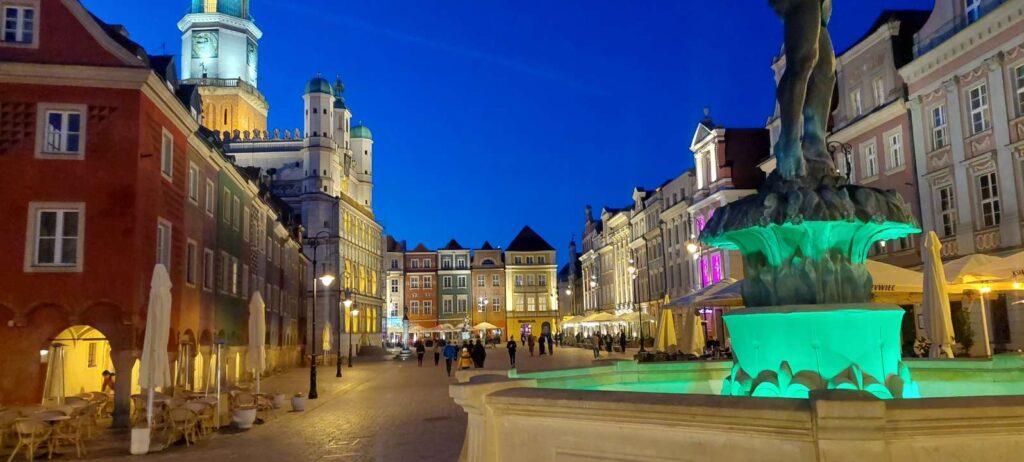
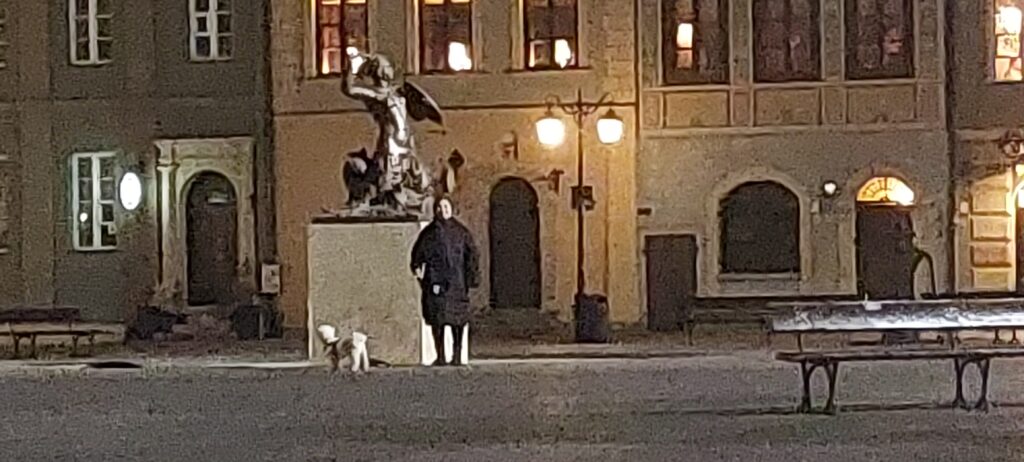
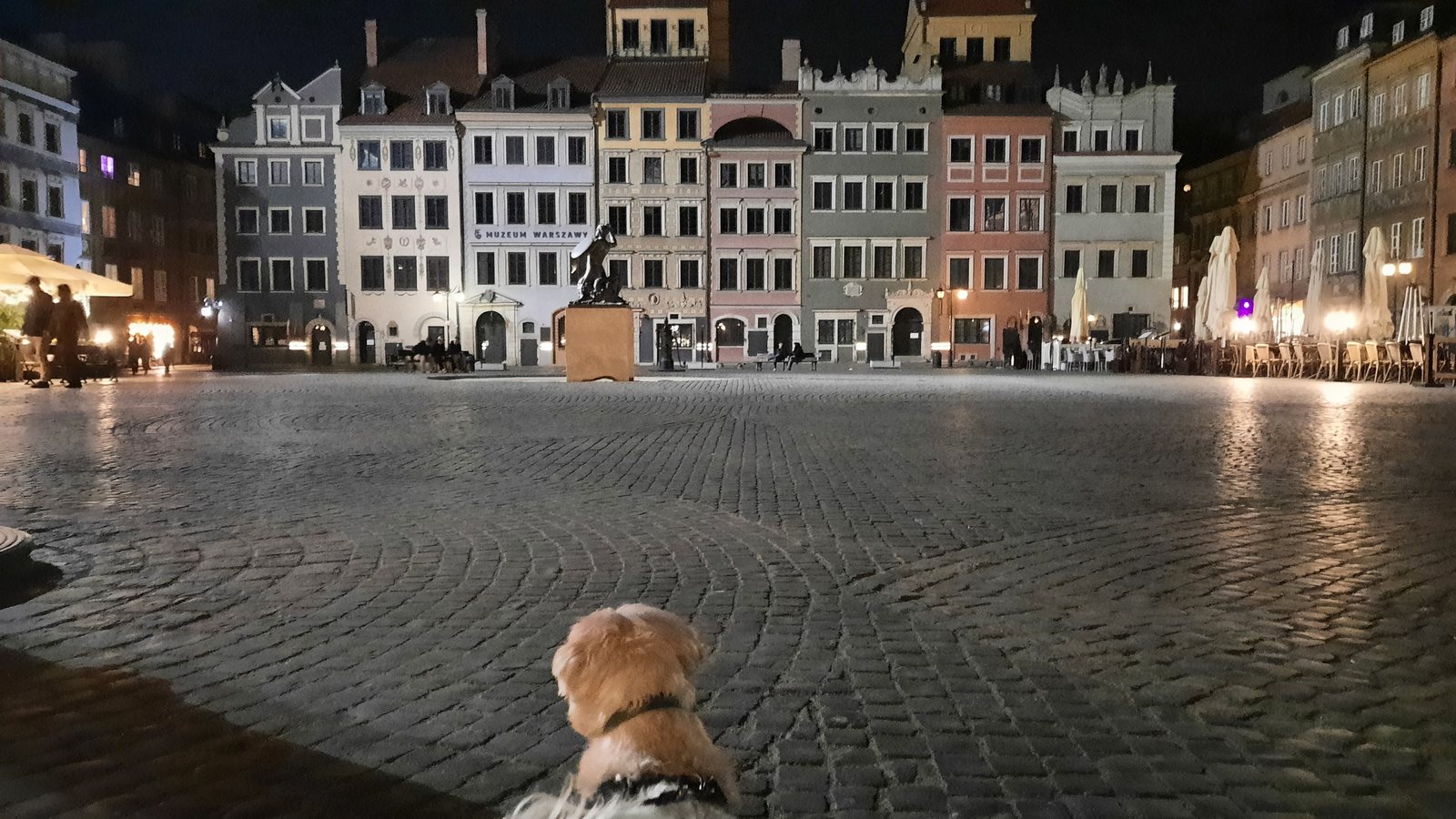
    the old town square in poznan at night with a green lid fountain
    Poznan Old Town Square at night is full of people – and you might get approached and invited in to clubs and bars

    We want to be straight with you, because no one else seems to be. Most of Poznań is a delight; a few of its edges just aren’t in the brochure, and you’ll be more relaxed if you know about them in advance.

    ℹ️ On the square — visible homelessness and begging

    Poznań’s Old Market Square has a visible community of people living rough — we saw the same faces every day across our twelve days, resting on the benches, and we were sometimes asked for money. On a few occasions we watched someone lift a half-finished glass of beer straight from a restaurant table; the staff noticed but rarely did much. Nothing ever came of it and we never once felt threatened — but it’s a side of the square we simply didn’t meet in Warsaw or Kraków, so we’d rather you know than be surprised. Keep an eye on your table and belongings as you would anywhere, and there’s no cause for alarm.

    ⚠️ Men on their own — the gentlemen’s club touts

    On the square after about 21:00, men on their own should expect to be approached — by both men and women — with a friendly manner and an invitation into one of the “gentlemen’s clubs.” These are strip clubs, and they’re tied to a scam documented right across Poland: a friendly tout lures visitors in with a free drink, after which victims face wildly inflated bills, credit-card overcharges, and — in many reports — spiked drinks. In 2019 the US Embassy in Warsaw issued a formal security alert about exactly this. We only ever saw these places from the outside, but the pattern is well known and the same faces worked the square every night. The safe move is a polite “no thank you” and to keep walking.

    💡 On the bar street — the “free drink” voucher trick

    You’ll be handed vouchers or coupons for a free drink by young people working for the bars. It’s a soft trap: when you actually get inside to claim it, the free drink has always “just run out” — but now you’re in the bar, and they’re hoping you’ll order something anyway. Not dangerous, just a small hustle worth recognising. On weekday evenings the bar street is lively and pleasant; on Friday and Saturday nights it becomes a crush of drinking crowds — stressful for a dog and best skipped with one at your feet.

    None of this makes Poznań a bad place to visit with a dog; it just means you plan around it. Walk the centre by day and midweek, keep the dog well clear of the bar street after dark on weekends, decline the touts and the vouchers, and you’ll have the good version of the city.

    The Old Market Square: two town halls, and the goats

    The Stary Rynek is ringed with colourful merchant houses. On it stands the Renaissance Old Town Hall, whose mechanical billy goats butt heads above the clock every day at noon — Poznań’s signature moment.
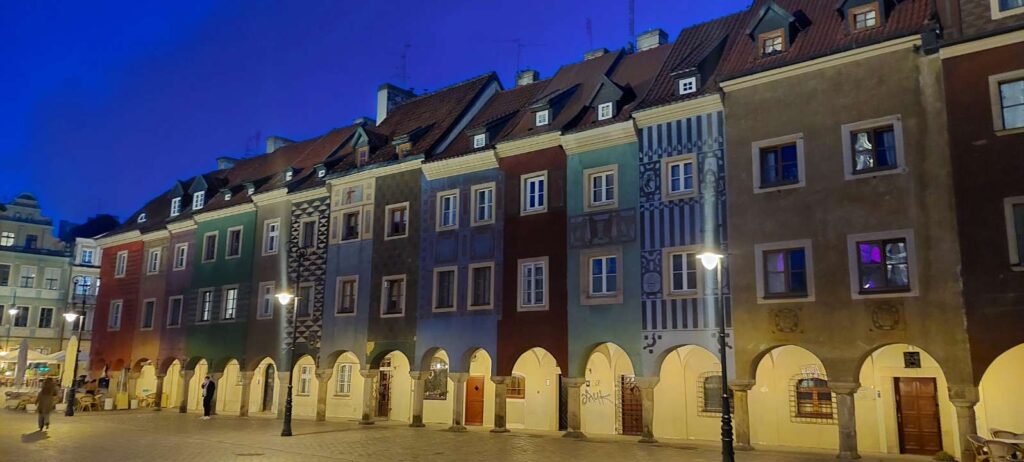
    The colorful merchant houses at Poznan old square at night
    The colorful merchant houses in Poznan

    The Old Market Square is the reason to come. The little row of painted merchant houses — the Domki Budnicze — is postcard-perfect, and the salmon-and-green Renaissance Old Town Hall (the Ratusz) dominates one side. Its famous trick happens at noon: two mechanical billy goats emerge above the clock face and butt heads, a ritual crowds gather for daily. We never did catch the mechanical goats at the right hour — but, in a coincidence Poznań seemed to arrange on purpose, we did once meet a woman on the square with two real, tiny live goats. The city has a sense of humour.

    The hidden courtyard: the New City Hall at night

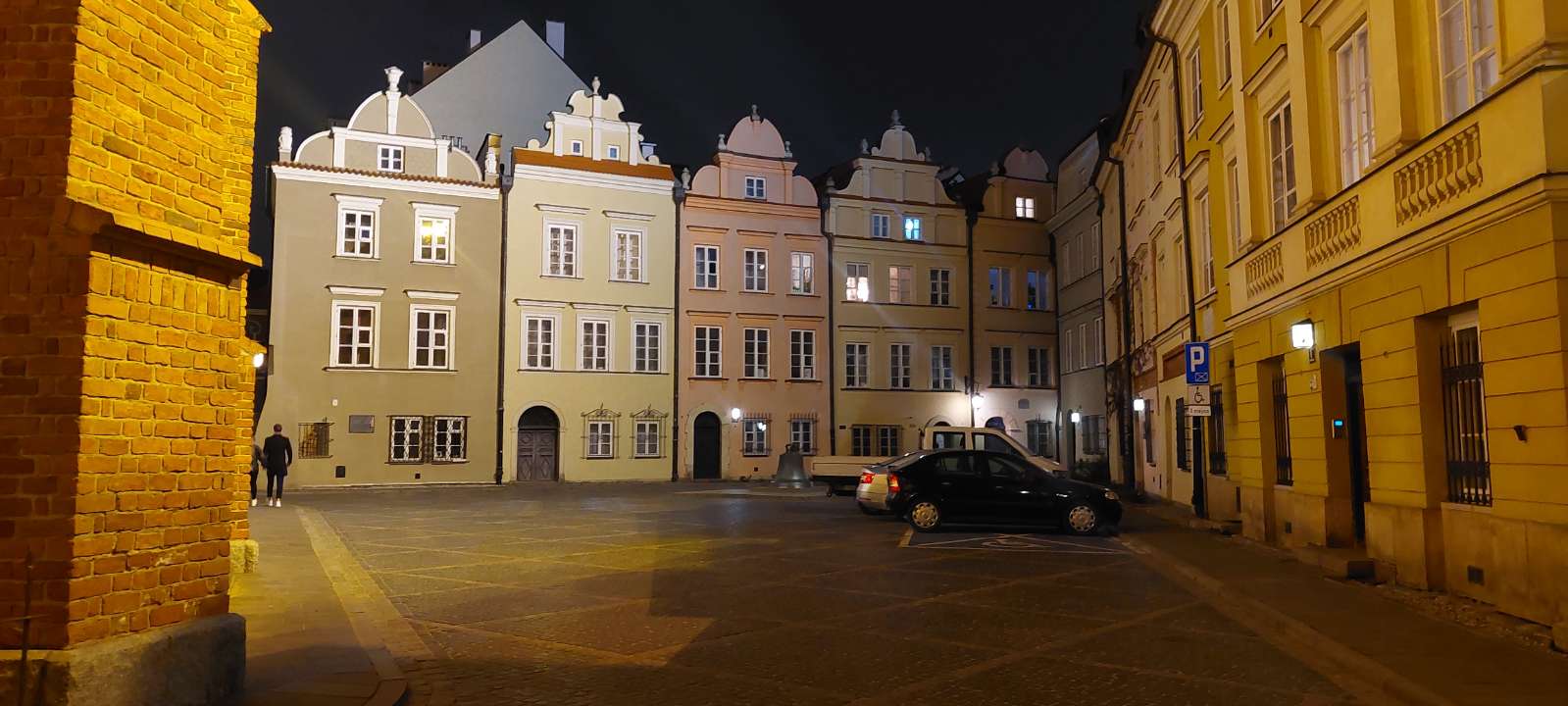
    Turn off the loud bar street into a quiet side street and you can reach the courtyard of the New City Hall — a floodlit, near-empty baroque space that carries the same fairy-tale hush we loved in Warsaw. The contrast is the whole magic.
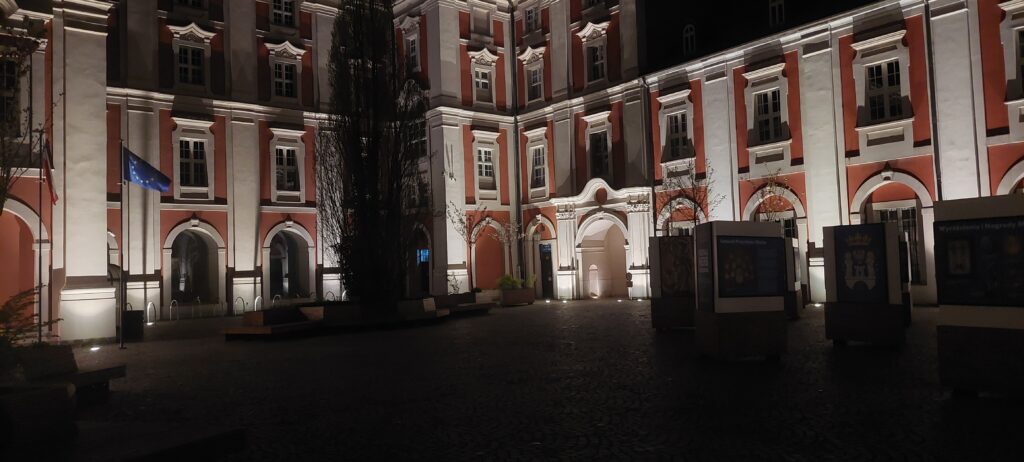
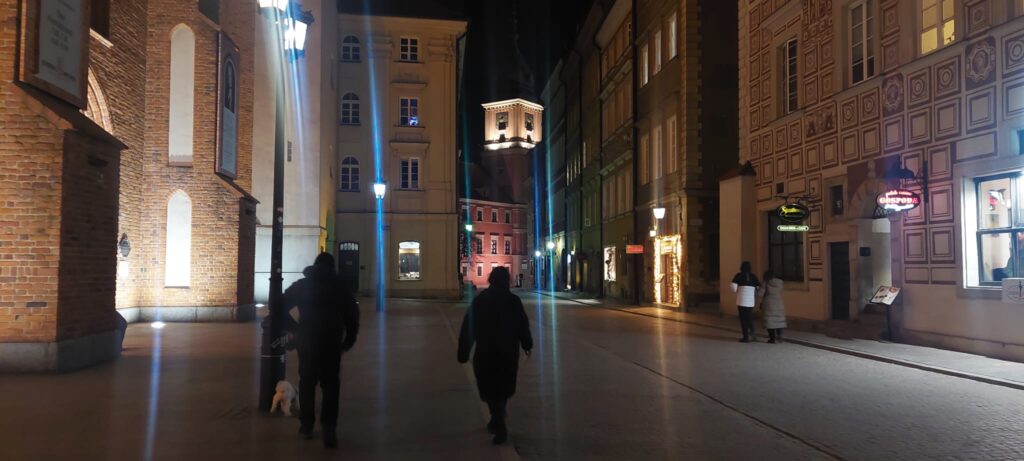
    Poznan City Hall court yeard at night is quiet
    The courtyard of the City Hall in Poznan is open at night and has that magic fairytale feeling that we love

    This was our favourite discovery in Poznań, and it came from walking away from the noise. One night, escaping the crowds near the square, we turned into a hushed side street — and through an open gate found the courtyard of the New City Hall (the Nowy Ratusz), the city’s salmon-pink municipal building, floodlit and completely still. After the din of the bar street it felt like stepping into another century. (Refurbished in recent years, the courtyard is a genuinely lovely piece of civic architecture.) The gate was open when we passed late at night; it may not always be, so treat it as a happy accident rather than a guarantee. If you find it open, step in quietly — it was the most magical two minutes of our stay.

    Walks from the door — and the broken-glass warning

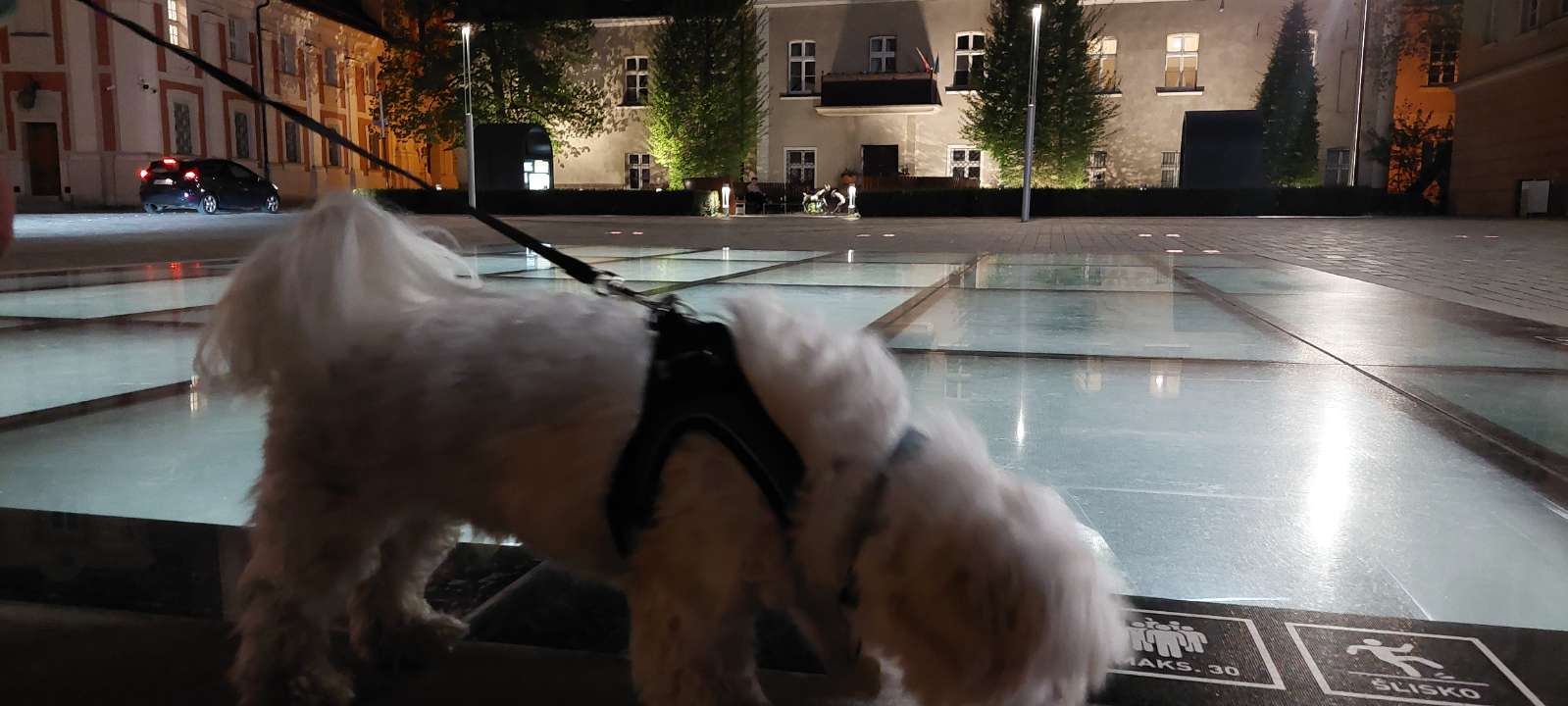
    Poznań is mostly city walking — pavements and cobbles rather than parks. The one genuine hazard: we found more broken glass on the streets here than anywhere else on the trip, so watch the ground and check your dog’s paws after walks.
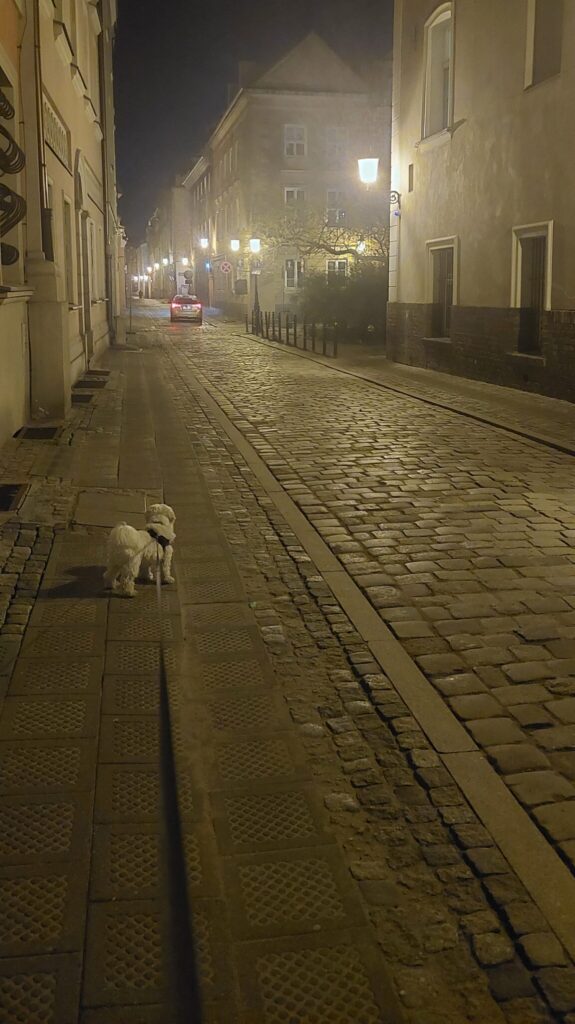
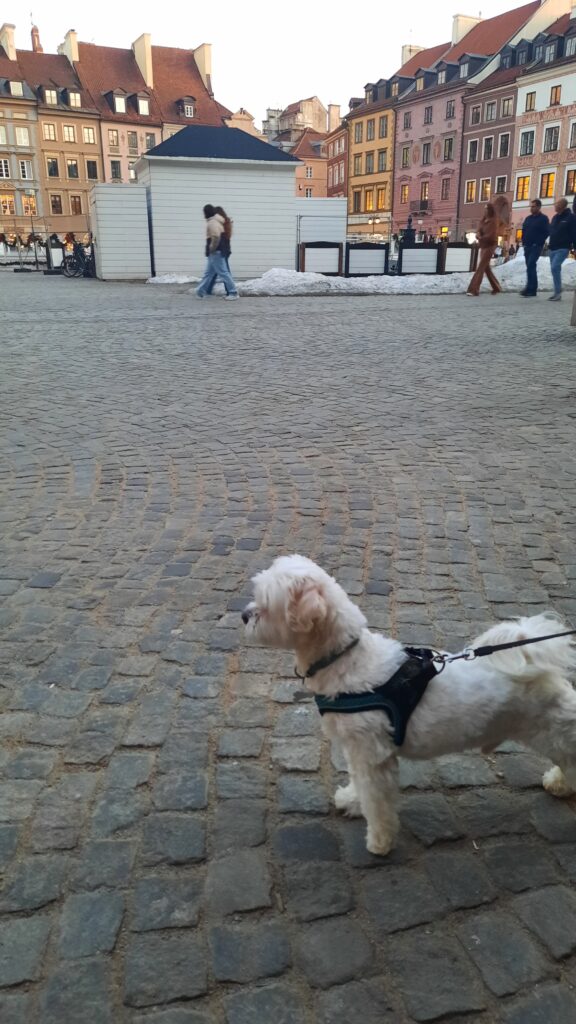
    dog walk in the side street of the old town in Poznan
    Dog walks at night in Poznan with Sofus was magic – but watch out for broken glass

    Be ready for less green than Warsaw offered. From our base near the centre, most walks were urban loops — out to the Old Market Square and back, or along the main pedestrian shopping street. The one real patch of central green is the small park beside the Town Hall; if your dog wants grass rather than cobbles, that’s essentially it, though the converted Stary Browar brewery-mall to the west has a pleasant park beside it and makes a good slightly-longer outing. Some of our nicest walks were simply short evening loops in the immediate neighbourhood. But the thing we’d most want you to know is practical and unglamorous: watch for broken glass. We came across it repeatedly, more than anywhere else on the two months, and with a dog padding along on bare paws it matters. Keep half an eye on the ground ahead and check the pads after every walk. It never hurt Sofus — only because we were looking for it.

    The night Sofus howled at the clock

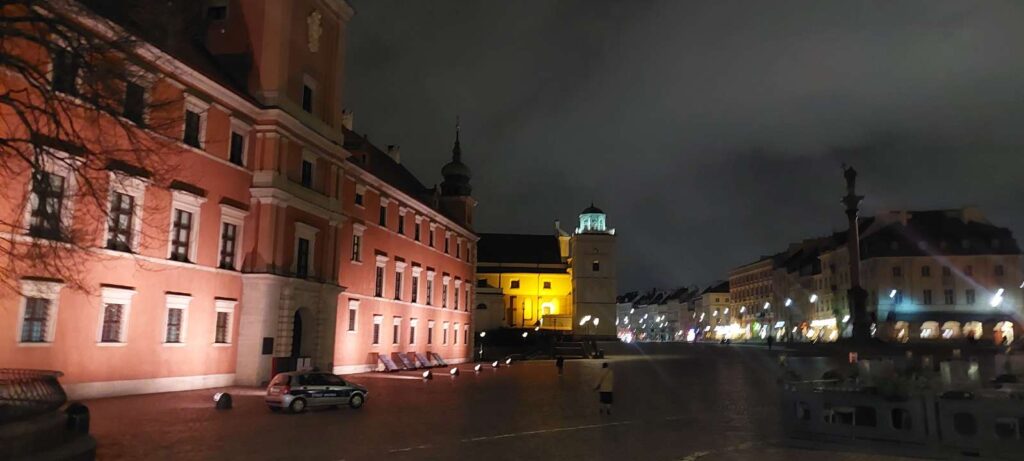
    On one of our last evenings, standing on the square as the Old Town Hall clock struck eight, Sofus threw his head back and howled — the funniest, most unexpected moment of the whole city.

    Poznan old town hall with the ratusz renaissance clock tower
    The Old Town Hall with the clock tower and the goats – Sofus howled late one night when we heard the bell

    We’ll leave you with this. On one of our final nights, we were standing in the Old Market Square when the clock on the Old Town Hall began to strike eight. On about the third chime, Sofus — who had walked through five weeks of Poland without a peep — lifted his head and howled, long and operatic, at the bell. We laughed until we couldn’t. He has never done it before or since. Whatever he was trying to tell Poznań, the city and the dog seemed, for one ringing minute, to understand each other perfectly.

    FAQ

    Is Poznań dog-friendly?

    Yes. It’s compact and easy to get around with a small dog, and the Green Caffè Nero chain reliably welcomes dogs and brings water. The main caveat is the weekend nightlife street, which gets crowded and rowdy after dark and is best avoided with a dog.

    What is there to see on Poznań’s Old Market Square?

    The colourful row of merchant houses (the Domki Budnicze) and the Renaissance Old Town Hall, whose mechanical billy goats butt heads above the clock every day at noon — the city’s best-known sight.

    Is Poznań safe to walk a dog at night?

    Midweek and by day the centre is calm and pleasant. On Friday and Saturday nights the bar street draws heavy drinking crowds and there’s more visible street activity than in Warsaw, so we’d keep a dog well away from that street after dark and stick to the square and quieter side streets.

    Are there parks in Poznań for dogs?

    Not many centrally. The small park beside the Town Hall is the main patch of green in the centre; the Stary Browar brewery-mall to the west has a park beside it and makes a good longer walk. Otherwise Poznań is mostly pavement-and-cobble city walking.

    Is there a lot of homelessness or begging in Poznań’s Old Market Square?

    More than we saw in Warsaw or Kraków. Across twelve days there was a visible community of people sleeping rough on the square, we were occasionally asked for money, and a few times someone took a half-finished drink from a restaurant table. It never felt threatening — just keep an eye on your table and belongings as you would anywhere.

    Are the free-drink vouchers on Poznań’s bar street a scam?

    They’re a soft hustle rather than a scam: young people hand out coupons for a free drink, but once you’re inside the bar the free drink has always “just run out” — the point was simply to get you through the door in the hope you’ll buy something. More serious are the strip-club touts on the square after about 21:00, who invite men into “gentlemen’s clubs” that are tied to a scam documented across Poland — inflated bills, card overcharges and, in many reports, spiked drinks. The US Embassy in Warsaw has issued a formal alert about it. Decline politely and keep walking.

    Any hazards to watch for when walking a dog in Poznań?

    Broken glass. We encountered it on the streets far more often here than anywhere else on our trip, so keep an eye on the ground and check your dog’s paw pads after every walk.

    Poznań was one city of three, on a two-month journey by train. The full guide has where we stayed, every walk from the door, what it all cost, and the honest version of each stop. €19, instant PDF plus a phone-friendly online version.

    Get the guide — €19

    Karen Svold Coates, author of EuroDogTravels

    Karen Svold Coates — M.Sc. Biology (Aarhus University), professional linguist with 11+ years in localization QA.

    Karen, Carl and Daniel travel Europe by train with Sofus, their 6.2 kg Coton de Tuléar, and document every route firsthand. Everything on this page was verified in person in spring 2026. This is our experience, not official advice — places change, so check current details before you go. Found something that’s changed? Tell us and we’ll fix it.

  • Warsaw with a dog

    Warsaw with a dog

    By Karen Svold Coates, M.Sc. Biology · Verified in person, spring 2026 · Last updated July 2026

    Warsaw With a Dog: Where to Stay, the Dog-Friendly Cafés & the Walks That Made Five Weeks (Tested 2026)

    Warsaw is one of the most dog-friendly cities we visited on our whole trip. Cafés and restaurants routinely welcome dogs inside, the Green Caffè Nero chain brings a bowl of water unprompted, the Old Town is walkable and — thanks to a heavy police presence — feels genuinely safe at any hour. We spent five weeks based in the Old Town in spring 2026, working remotely, with Sofus, our 6.2 kg Coton de Tuléar. Below: where to stay, the cafés that took him in, the four walks we did straight from the door, how to handle Uber with a dog, and why we never once felt uneasy walking late at night.

    Five weeks is long enough to stop being a tourist and start having a routine. This is the Warsaw we’d hand you on your first morning.

    Is Warsaw dog-friendly?

    Yes — markedly so. Many Warsaw cafés and restaurants allow dogs inside, not just on the terrace, and the ubiquitous Green Caffè Nero reliably welcomes small dogs and brings water for them.

    Of the cities we stayed in, Warsaw was among the warmest toward Sofus. People smiled when they noticed him at outdoor tables; strangers stopped to say hello; late-night walkers in the empty Old Town wanted to meet him. That everyday friendliness matters more than any single dog park — with a small dog who likes to be where the people are, being welcome inside is what makes a city liveable rather than just visitable. If you’re flying in first, our LOT cabin flight to Warsaw covers the arrival end.

    Where to stay in Warsaw with a dog: the Old Town

    Stay in or near the Old Town so every walk out the door is already somewhere. The trade-off: modern Warsaw’s big museums and larger supermarkets are a 15–20 minute Uber away.

    We took a long time choosing our apartment and booked five weeks over Easter on one principle: we wanted a base where every walk was already a destination. Warsaw Old Town is exactly that. From our flat on Brzozowa Street, every direction offered something, and there are small supermarkets and countless cafés within the Old Town itself. The honest trade-off is that the Old Town isn’t central to the modern city — the Warsaw Uprising Museum, the POLIN Museum of Jewish History and the bigger shops all needed a short ride. We weighed it carefully and would make the same choice again without hesitating.

    Sofus, a small white Coton de Tuléar, standing on the cobblestones of Warsaw's Old Town Market Square in front of the colourful reconstructed townhouses
    Sofus in the Old Town Market Square — five weeks of mornings began here.

    The best walks from the door

    Four walks radiate from the Old Town, all on foot in roughly 20 minutes or less: up to Castle Square, left to the fountain, right to the Fountain Park, and down to the Vistula riverside. No transport needed for any of them.

    The quiet luxury of the Old Town is that Sofus never needed a car to reach a good walk. Over five weeks we wore in four favourites:

    Walk Direction from the Old Town What’s there Good for
    The everyday loop Up, to Castle Square Sigismund’s Column, Castle Square, the Old Town proper — magically empty late at night Your default; endlessly walkable
    To the fountain Left, toward the river Restauracja Fontanna (dogs welcome on the terrace) — note the fountain itself only runs from May A short walk with a coffee at the end
    The Fountain Park Right, along the river Open green space around the Multimedia Fountain; busy with walkers and cyclists at weekends When your dog wants grass, not cobbles
    The big Sunday walk Down, across the road to the Vistula The riverside bulwary promenade and a riverside Green Caffè Nero; lively, and full of other dogs The long weekend outing (our favourite)
    All four start from the Old Town — drop the endpoints into Google Maps and walk them yourself. Verified spring 2026.

    The everyday loop up to Castle Square never got old, and the Old Town square late at night — all but empty, immaculately lit — was among the best things Warsaw gave us. The big Sunday walk down to the Vistula was our favourite, though it’s also where Sofus met a young pug who took firmly against him, so he spent that visit on our laps rather than making friends. Dogs don’t always love each other, even on holiday.

    Our daily late night walk with Sofus – he is sniffing the lamp post!

    Dog-friendly cafés and restaurants in Warsaw

    Green Caffè Nero is the reliable default — dog-welcoming across the city and they bring water unprompted. Elsewhere, look for a dog sticker on the door, or send one person in to ask before you all sit down.

    Sofus the dog is sitting in a couch with Carl in Caffe Nero Green
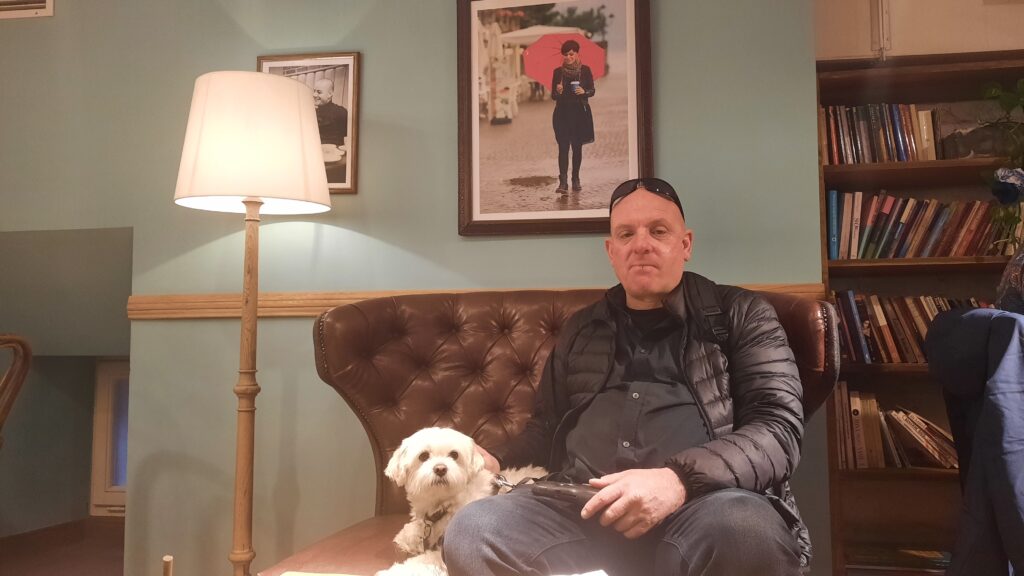
    Sofus enjoyed the homely feeling of Caffe Nero Green at Green Caffè Nero at Plac Zamkowy next to the Castle Square

    Wherever you walk in the Old Town you’re rarely far from a Green Caffè Nero, and knowing one reliably dog-friendly chain took the strain out of long afternoons — Sofus would lie quietly while we had a coffee.

    Restauracja Fontanna, beside the large fountain closer to the river, welcomes dogs on its terrace and became one of our reward stops. For anywhere without an obvious dog sign, the low-stress method is the one we used all trip: one of us went in to ask while the others waited outside with Sofus, so we never risked an awkward refusal at the table. Casual places said yes almost every time.

    Our favourite thing: a bench, the square, and a Tymbark

    The permanent stone benches around the Old Town square are free and have exactly the view of the paid restaurant chairs. Sit with a cheap bottle of Tymbark juice and let the square come to you.

    This was our single favourite thing across the whole five weeks. We’d buy a Tymbark — a Polish fruit juice, sold in small bottles at the nearby supermarket for a fraction of a café price — sit on a stone bench, watch the square, and let Sofus investigate the cobblestones. We did it in the cold and the warmth, morning and evening. We recommend it without reservation. Bring a Tymbark.

    Getting around Warsaw with a dog: Uber

    Uber is reliable and dog-accommodating. Book, then immediately message the driver — “small dog in a carrier, plus luggage” — and track their real-time location, because the map pin is often wrong in the Old Town.

    We used Uber consistently and every driver we met was happy to take Sofus in his carrier. Two practical notes. First, message the driver the moment you book, naming the dog, the luggage and a clear landmark — it heads off any surprise at the kerb. Second, vehicle access in the Old Town is restricted, so drivers often wait on an adjacent street rather than at the pin; watch their moving location on the map instead of standing at the marked spot. Drivers will also usually ask “karta?” — cards are accepted almost everywhere.

    Is Warsaw safe to walk a dog at night?

    Yes. The Old Town has a substantial, visible police presence and the streets are immaculately clean; we walked late at night for five weeks and never once felt uneasy.

    We stayed in Warsaw for five weeks including Easter, when the Good Friday procession filled the streets with officers, and across our stay there were regular weekend gatherings — a Belarusian freedom event, a football-match crowd, Saturday marches. We want to be plain about how it felt: extremely safe. Warsaw Old Town is one of the safest environments we’ve ever walked a dog in, at any hour — which is exactly what makes those late-night square walks the highlight they are.

    Practical etiquette and what to watch for

    Say “dzień dobry” entering a shop and “dziękuję” leaving; cards work almost everywhere; and watch the cobblestones — they’ll turn your ankle if you’re not paying attention.

    A few small things smooth the days. The Polish greeting-and-thanks on entering and leaving a shop is non-negotiable courtesy and always warmly received. Payment is overwhelmingly cashless. And the one genuine hazard is underfoot: the Old Town’s beautiful cobblestones are uneven, and it’s easy to roll an ankle while you’re watching the dog instead of the ground. On the toilet front, big squares and stations tempt a dog toward pillars and posts — we cover that fully in how a dog manages the toilet on long travel days. When it’s time to move on, Warsaw’s onward train links are excellent; we took the train south toward Kraków next.

    FAQ

    Is Warsaw dog-friendly?

    Very. Many cafés and restaurants allow dogs inside, and the Green Caffè Nero chain reliably welcomes small dogs and brings water for them. Of the cities on our two-month trip, Warsaw was among the warmest toward our dog.

    Where should I stay in Warsaw with a dog?

    The Old Town, if you can. Every walk from the door is already somewhere — Castle Square, the river, the fountain park — with no transport needed. The trade-off is that modern Warsaw’s big museums and larger shops are a 15–20 minute Uber away.

    Can I take a dog in an Uber in Warsaw?

    Yes, and we found drivers consistently accommodating. Message the driver right after booking to say you have a small dog in a carrier plus luggage, and track their real-time location, because in the Old Town they often wait on a nearby street rather than at the map pin.

    Are dogs allowed in Warsaw cafés and restaurants?

    Frequently, yes — often inside, not just on the terrace. Green Caffè Nero is the reliable default. For anywhere without an obvious dog sign, send one person in to ask before the group sits down; casual places nearly always say yes.

    Is Warsaw Old Town safe at night?

    In our five weeks there, extremely. The area has a heavy, visible police presence and immaculately clean streets, and we walked late at night regularly without ever feeling uneasy.

    Warsaw was one city of three, plus one cabin flight and five train operators. The full guide covers the whole journey — where we stayed, what it all cost, the carrier bags we got wrong, and everything else we learned. €19, instant PDF plus a phone-friendly online version.

    Get the guide — €19

    Karen Svold Coates, author of EuroDogTravels

    Karen Svold Coates — M.Sc. Biology (Aarhus University), professional linguist with 11+ years in localization QA.

    Karen, Carl and Daniel travel Europe by train with Sofus, their 6.2 kg Coton de Tuléar, and document every route firsthand. Everything on this page was verified in person in spring 2026. This is our experience, not official advice — places and opening hours change, so check current details before you go. Found something that’s changed? Tell us and we’ll fix it.

  • How does a dog go to the toilet on a long train journey?

    How does a dog go to the toilet on a long train journey?

    By Karen Svold Coates, M.Sc. Biology · Verified in person, spring 2026 · Last updated July 2026

    How Does a Dog Go to the Toilet on a Long Train Journey? Two Months, Six-Hour Legs, Zero Accidents (Tested 2026)

    A house-trained dog usually does not need to relieve itself on a train, even for five or six hours, because it reads the carriage as an indoor space — a home — and a dog that is properly toilet-trained does not toilet indoors. The trick is not teaching your dog to “hold it” for hours; it is planning the day so it never has to. We traveled two months across Poland and Germany with Sofus, our 6.2 kg Coton de Tuléar, on legs of up to six hours, and he had not a single accident. Below: the one principle that makes it work, the morning routine, what to do about water, and the honest exception nobody warns you about — stations are harder than trains.

    This was the worry that kept us up before we left, and it turned out to be almost a non-issue. Here is the full picture.

    Do dogs need to pee on a long train journey?

    Most house-trained dogs don’t toilet on a train at all, even over five or six hours — they read the enclosed carriage as indoor space, like your living room, where they simply don’t go.

    This is the single most reassuring thing we learned, and it reframes the whole fear. When you imagine your dog on a six-hour train, you picture it desperate and suffering the entire time. That isn’t what happens with a potty-trained dog. Sofus wasn’t gritting his teeth and holding it — he genuinely didn’t register the train as a place to wee. He settled, he slept, and the question of the toilet quietly disappeared. The one honest caveat: this depends on your dog being genuinely house-trained — having learned that wee and poo are outdoor-only things. That’s the foundation the whole thing rests on; it isn’t something you can install the week before you travel.

    The one rule that makes it work: a five-hour ceiling

    Plan every travel day around a rough five-hour ceiling. Where a single leg runs longer, find the toilet break inside it — a connection, a long scheduled stop, or the gap before boarding.

    That planning is the real answer to the toilet question — not your dog’s bladder, but your timetable. A few examples from our actual trip:

    • Before the flight from Copenhagen, we gave Sofus ten to fifteen minutes on the grass outside the terminal — not a proper walk, just enough time to wee several times before a couple of hours in the cabin.
    • The ComfortJet from Berlin to Odense was about six hours inside the train, and it was completely fine — the “home” principle carried it. As it happened, the train stood still in Hamburg for a full hour in those early weeks, and Carl simply took Sofus off for a wee halfway through the longest train day of the trip. (That long Hamburg stop was a temporary diversion; check the current timetable, because it may be gone.)
    • On the way home we had about an hour in Odense before the last Danish trains — one built-in break that made a crowded evening leg effortless.

    Read your route the same way, and treat the natural pauses as your toilet stops rather than the stations themselves. We planned every one of these breaks in advance; the full day-by-day timetable, with the exact legs and their durations, is laid out in our guide.

    The morning routine before a travel day

    Start every travel day with a long walk and make sure your dog has actually pooped before you leave. A dog that has emptied out boards the train with nothing pressing.

    Sofus, a small white Coton de Tuléar in a harness, on his long morning walk across Warsaw's Old Town Market Square before a travel day
    A long morning walk in Warsaw’s Old Town before a travel day

    This is the half of the routine first-timers forget, and it’s the half that matters most. Sofus is regular — he poos morning and evening most days — so we planned the hard travel around his rhythm rather than fighting it. Know your own dog’s rhythm and schedule the difficult legs around it; a dog that usually goes at 8am should not be sealed into a carrier at 7:30.

    Water: what to do before boarding

    Limit water in the hour or two before a long leg — not to the point of thirst, just enough that nothing is urgent — then offer it freely once you’re settled. A lighter stomach also helps with motion sickness.

    There’s a related reason to go easy on the stomach before travel, and it isn’t about the toilet: dogs get motion sickness much as people do. After Sofus was sick exactly once — on the PKP Intercity leg, with a well-dressed stranger diplomatically pretending to sleep — we learned to limit his food in the hours before a long train or a flight. If your dog is genuinely prone to travel sickness, ask your vet before you go about anti-nausea options made for dogs.

    The honest exception: stations are harder than trains

    Stations, not trains, are the tricky part. A big terminal is indoors but full of pillars and walls that look like lampposts — keep your dog moving and away from them.

    A big station is a confusing in-between for a dog: indoors, but vast, public, and full of vertical things that look exactly like the lampposts it’s allowed to use outside. Sofus read columns and walls in the big Polish and German stations as fair game, and had to be steered away more than once. So the practical rule is the opposite of what you’d expect: relax on the train, stay alert in the station. And a point of etiquette that’s also the law in much of the EU — don’t let your dog wee on the platform or against station lampposts. It’s frowned upon and, in some places, finable. If your dog needs to go and you’re between the station and the train, get it to a proper patch of grass outside first.

    What about puppies and dogs that aren’t fully trained?

    For a puppy or a dog still in training, use puppy pads or a travel diaper. The “train is a home” principle only works once the outdoor-only lesson is solid.

    There’s no shame in the fallback. For a puppy, bring a supply of pads, offer one during any long stationary stretch, and accept that early trips are practice. For a dog mid-training, a well-fitted travel diaper takes the anxiety out of a long leg entirely. Use these as the safety net that lets you travel now, while the training catches up.

    How the toilet worked on our longest legs (verified spring 2026)

    Over legs of up to six hours, our dog never had a single accident. Here is exactly how each of our longest journeys was handled.

    Leg Approx. duration Toilet break available? What we did How it went
    Copenhagen Airport → Warsaw (LOT, cabin) ~2 hrs door-to-seat + flight Yes, before boarding 10–15 min on grass outside the terminal to wee No issue
    Warsaw → Kraków (RegioJet) ~3 hrs, non-stop No — no station break at all Limited water beforehand, long walk before entering the station No issue
    Berlin → Odense (ComfortJet) ~6 hrs, inside the train Unplanned 1-hr Hamburg stop Used the Hamburg stop for a wee; otherwise the “home” principle held No issue
    Odense → home (DSB) Short final legs Yes — ~1 hr in Odense Full walk and wee in Odense before the last trains No issue
    Verified in person, spring 2026. Rules and timetables change — write to us and we’ll update it.

    FAQ

    How long can a dog hold its bladder on a train?

    A healthy adult dog can comfortably go five to six hours without a toilet break, and a house-trained dog on a train usually doesn’t feel the need to go at all, because it reads the carriage as indoor space. Plan a break roughly every five hours anyway, and you’ll never test the limit.

    Will my dog have an accident on the train?

    A properly house-trained dog is very unlikely to toilet on a train — it treats the carriage like your living room. Over two months and legs of up to six hours, our dog never once did. Puppies and dogs still in training are the exception; use puppy pads or a travel diaper for them.

    Should I give my dog water on a long train journey?

    Limit water in the hour or two before a long leg so there’s nothing urgent to pass, then offer it freely once you’re settled. Keeping the stomach light before travel also helps with motion sickness.

    How do I get my dog to the toilet during a journey with no stops?

    Build the break into your plan rather than the train: use connections, long scheduled stops, and the gap before boarding. A thorough morning walk — making sure your dog has pooped before you leave — is what makes a stopless leg like a non-stop three-hour train painless.

    Can my dog pee on the station platform?

    No — weeing on platforms and station lampposts is frowned upon and finable in much of the EU. Stations are also where dogs are most tempted, since pillars and walls look like lampposts, so keep your dog moving and take it to grass outside if it needs to go.

    This is one worry, answered. The full guide covers the whole journey — five train operators, three cities, one cabin flight, the carrier bags we got wrong, the costs, and everything else we learned. €19, instant PDF plus a phone-friendly online version.
    Get the guide — €19

    Karen Svold Coates, author of EuroDogTravels

    Karen Svold Coates — M.Sc. Biology (Aarhus University), professional linguist with 11+ years in localization QA.

    Karen, Carl and Daniel travel Europe by train with Sofus, their 6.2 kg Coton de Tuléar, and document every route firsthand. Everything on this page was verified in person in spring 2026. This is our experience, not veterinary advice — always check what’s right for your own dog with your vet. Found something that’s changed? Tell us and we’ll fix it.

  • Book your dog’s AHC vet appointment now

    Book your dog’s AHC vet appointment now

    By Karen Svold Coates, M.Sc. Biology · Explainer based on official UK guidance & reported experience · Last updated June 2026

    Book Your Dog’s Travel Vet Now: the Summer Animal Health Certificate Appointment Crunch

    If you’re a GB resident planning a summer trip to the EU with your dog, book your AHC vet appointment now — because the Animal Health Certificate (AHC) you now need has a tight 10-day issue window, only certain vets can issue it, and summer is exactly when those appointments fill up. Owners have reportedly been turned away at the airport because their vet was fully booked and couldn’t issue the certificate in time. Here’s why the crunch happens, how far ahead to book, and how to avoid being caught out — drawn from official UK guidance and widely reported traveller experience.

    A note on where this comes from: we’re an EU-resident family who travel Europe with our own dog, so we know these documents well — but we’re not UK residents and haven’t been through the GB AHC process ourselves. This is a plain-English explainer of the official rules and of what UK travellers are reporting, not a personal account. Always confirm current requirements on GOV.UK and with your own vet.

    Why summer is the crunch point

    The AHC must be issued within 10 days of travel, only an APHA-authorised vet can issue it, and everyone travelling in the school holidays needs one at the same time — so appointments concentrate into a narrow, busy window.

    Three things collide in July and August. First, the certificate is time-boxed: it has to be issued in the 10 days before you travel, so you can’t just get it done months early and relax. Second, not every practice can issue one — it must be an APHA-authorised “Official Veterinarian,” and there are far fewer of those than there are vets. Third, the entire holidaying population is trying to book that same narrow slot in the same few weeks. The result is predictable: limited authorised vets, a tight window, peak demand. If you leave it late, you may not get a slot in time.

    What actually goes wrong

    The reported failure is stark: owners arriving at the airport or terminal without a valid AHC because their vet couldn’t fit them in, and being refused travel.

    This is the part that turns a paperwork detail into a ruined holiday. Travellers have reported being turned away because the certificate wasn’t issued in time — an authorised vet was fully booked, or the appointment fell outside the 10-day window, or a required step (like the rabies timing) hadn’t been met early enough. Unlike a delayed flight, there’s no fixing this at the gate: no valid AHC, no travel.

    How far ahead to book — the timeline

    Book the AHC appointment for the 10 days before departure, but reserve that slot weeks ahead. And check the rabies vaccination is valid and was given at least 21 days before you travel.

    The two clocks to plan around:

    • Rabies — weeks ahead. The rabies vaccination must be in date and given at least 21 days before travel. This is the one that can’t be fixed last-minute, so confirm it first.
    • The AHC — issued in the final 10 days, but booked far earlier. The certificate itself must be issued within 10 days of your arrival at the EU border. So the appointment has to fall in that window — but you should reserve the slot with an authorised vet well in advance, ideally as soon as you know your travel dates. Booking two weeks or more ahead of departure is the commonly advised minimum, and in summer, earlier is safer.

    In practice: the moment your trip is booked, find an APHA-authorised vet and reserve the AHC appointment for the correct window. Don’t wait until the week before.

    Don’t forget the tapeworm window for some destinations

    For dogs travelling to Ireland, Northern Ireland, Finland, Malta or Norway — and for the return to Great Britain — a vet must give a tapeworm treatment 24–120 hours before entry. That’s another appointment to plan.

    The return leg catches people out especially: to bring your dog back into Great Britain, a vet in Europe must administer a tapeworm treatment in a narrow 1–5 day window before you travel back. In a busy tourist area in summer, finding an available vet for that on the right day takes planning too — so research a clinic near your departure point before you go.

    How to avoid the crunch — a short checklist

    • Book your trip, then immediately find an APHA-authorised vet — not every practice qualifies, so ask specifically.
    • Confirm your dog’s microchip and rabies vaccination are valid, with the rabies shot at least 21 days before travel.
    • Reserve the AHC appointment for the 10 days before departure — weeks in advance, especially in summer.
    • If your route needs it, plan the tapeworm treatment (including a return-leg vet in Europe).
    • Phone a few authorised vets to compare prices — the same certificate varies a lot between clinics.
    • Carry printed copies of everything, and keep your dog’s records (including any EU pet passport as a medical record) to hand.

    The bigger picture

    Since 22 April 2026, GB residents can no longer use an EU pet passport to enter the EU and need an AHC for each trip — which is what created this summer bottleneck in the first place. If you’re not sure how the new rules work, our full explainer on the UK pet-passport change and the Animal Health Certificate walks through the whole thing. And always check GOV.UK for the current detail before you book.

    FAQ

    How far ahead should I book the vet for an AHC?

    Reserve the appointment as soon as your trip is booked. The AHC itself must be issued within 10 days of travel, but authorised vets fill up in summer, so booking the slot two weeks or more ahead of departure is the commonly advised minimum — earlier is safer.

    Why can’t I just get the AHC done early?

    Because it’s only valid if issued within 10 days of your arrival at the EU border. Done too early, it expires before you travel. So the appointment must fall in that final window — which is exactly why the slots are contested in peak season.

    Can any vet issue an Animal Health Certificate?

    No. It must be an APHA-authorised “Official Veterinarian.” Fewer practices qualify than you’d expect, so ask specifically when booking, and don’t assume your usual vet can do it.

    What happens if my vet can’t issue it in time?

    You may be refused travel. Reports describe owners turned away because the certificate wasn’t ready — there’s no way to fix a missing AHC at the airport or terminal, so the safeguard is booking early.

    What about getting my dog back into the UK?

    Your AHC covers re-entry to Great Britain for up to six months, but for the return you still need a vet in Europe to give a tapeworm treatment 24–120 hours before you travel back. Research an authorised clinic near your departure point in advance.

    Once the paperwork’s sorted, the fun part begins. Our guide covers travelling Europe with a dog by train and plane — routes, operators, carriers and honest costs, from a family who actually did it. €19, instant PDF plus a phone-friendly online version.
    Get the guide — €19

    Karen Svold Coates, author of EuroDogTravels

    Karen Svold Coates — M.Sc. Biology (Aarhus University), professional linguist with 11+ years in localization QA.

    Karen, Carl and Daniel travel Europe by train with Sofus, their 6.2 kg Coton de Tuléar. This article explains official UK guidance and reported traveller experience current as of June 2026; rules change and vary by destination — always confirm on GOV.UK and with your own vet before you travel. Found something that’s moved? Tell us and we’ll fix it.

    Official sources

    Always check current, official guidance before you travel:

  • What two months in Europe with a dog cost

    What two months in Europe with a dog cost

    By Karen Svold Coates, M.Sc. Biology · First-hand: our own receipts, two months, spring 2026 · Last updated June 2026

    What Two Months in Europe With a Dog Really Cost — Real Numbers From Our Receipts (2026)

    Here’s the number most dog-travel articles won’t give you: bringing our 6.2 kg dog on a two-month trip through Poland and Germany cost us roughly $1,000–1,500 more than the same trip without him — and almost none of that was his ticket. Sofus’s train fares for the entire journey came to about €3.50. The real cost of travelling Europe with a dog is the shape of the trip a dog forces you into: no budget flights, longer rail journeys, and a dramatically smaller pool of apartments. We kept the receipts, and this is the honest breakdown — plus the one number about Booking.com that everyone planning a dog trip should see.

    The dog’s ticket is nearly free. The dog’s itinerary is not.

    Our dog’s fares: 15.20 zł (~€3.50) on Polish PKP Intercity, free on RegioJet, free on Deutsche Bahn. The expense hides in four decisions the dog rewrote — and each one cost real money.

    If you’re budgeting for a dog trip by looking up pet fares, you’re measuring the wrong thing. Here’s where the money actually went:

    The cheap flight disappeared. Without the dog, we’d have taken a budget return flight for about €92 per person. With a small dog, budget carriers and cabin travel barely mix — so that option simply vanished from the table.

    The train replaced it. Long rail journeys across a continent for three people cost far more than three budget plane seats. Wonderful — the trains became the heart of the trip — but a straightforward trade the dog caused.

    An extra city appeared. The rail route home meant two nights in Berlin we wouldn’t otherwise have taken: €264 in accommodation alone, plus meals and transport in one of the trip’s most expensive cities.

    Accommodation cost more. Not because dog-friendly places charge more in principle — but because the pool is smaller, so at any given budget you have fewer options, and the good-value ones go first. Which brings us to the number worth remembering.

    What “pets allowed” does to your apartment search

    Our sample Booking.com search for a month in Warsaw: about 2,300 apartments citywide — dropping to about 950 the moment we ticked “pets allowed.” Well over half the city’s apartments quietly vanish.

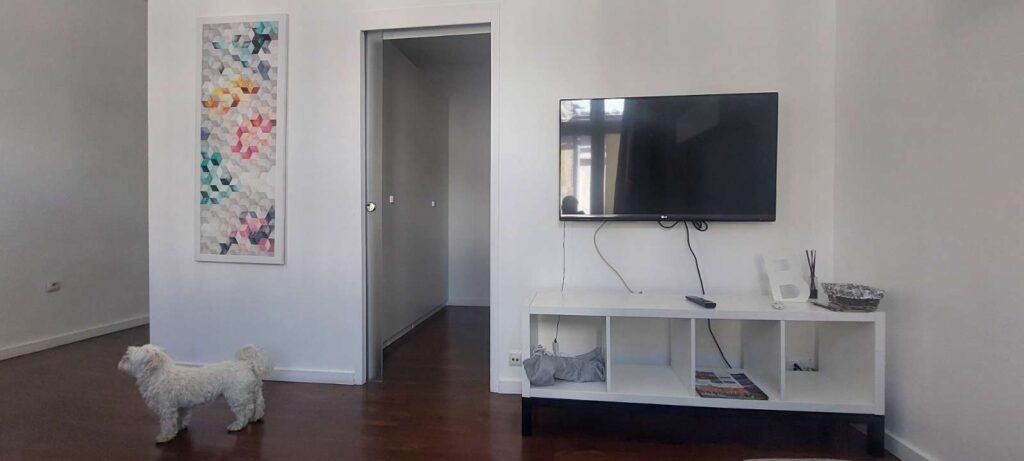
    a small white dog is standing in an apartment
    Sofus in one of our apartments in Krakow – there are fewer apartments to choose from when you travel with a dog

    This is the planning reality nobody quantifies, so we did. Searching a month-long Warsaw stay, roughly 60% of listings disappeared behind the pet filter. Narrow to the Old Town and it tightened further: of 71 apartments available for a month, 28 took dogs; for a single week, 42 of 128. (Searches done months ahead — exact numbers shift by season, but the proportion is the point.) And the later you book, the tighter it gets: looking for Kraków and Poznań apartments one to two weeks before arrival, the central, on-budget, dog-friendly overlap was a handful of options. The lesson: book early — the dog-friendly pool is small, and the well-priced places in it go first.

    Sample prices from our receipts, spring 2026

    Poland was the great bargain; Germany cost Danish prices. The gap shaped our whole budget.

    ItemWhat we paid
    Dog’s fare, PKP Kraków→Poznań15.20 zł (~€3.50)
    Dog’s fare, RegioJet & Deutsche BahnFree
    Comfort Uber across central Warsaw~€4–5
    Uber, Berlin station → Charlottenburg~€17
    Central dog-friendly apartment, Poznań~€57/night
    Apartment, Berlin~€132/night
    ComfortJet Berlin→Denmark, 3 people~€311 (dog free)
    Restaurant-car sandwich (ComfortJet)~€12
    The budget flight we didn’t take~€92/person return

    Two budgeting rules fell straight out of these numbers: use Polish Ubers freely (they’re nearly free) but treat German transport as a real line item; and buy train food at a supermarket before boarding — the restaurant car charges steeply for a dry sandwich.

    One piece of genuinely good money news

    We travelled two months across Poland and Germany almost entirely cashless. In all that time, exactly one shop refused a card.

    Every supermarket, bar, restaurant and corner shop took Visa or Mastercard with no minimums; Ubers were paid in-app. You don’t need to arrive with złoty or hunt exchange offices. Our one honest caveat: carry a few notes anyway — not for shops, but for the human moments a card can’t cover.

    So was it worth $1,000–1,500 extra?

    Yes — and we want both halves of that sentence visible. The number is real, and so is the answer.

    Everything that made the trip more expensive is also what made it the trip it was. The trains the dog required gave us a compartment of strangers who became friends. The Berlin stop he caused gave us days we’ll never forget. The dog who narrowed our apartment search also met every single person who stopped to say hello. We didn’t bring him to save money; we brought him because we’d have missed him too much to enjoy a single day. If your budget can absorb the difference, it’s the best money we spent — but you deserved the real figure first.

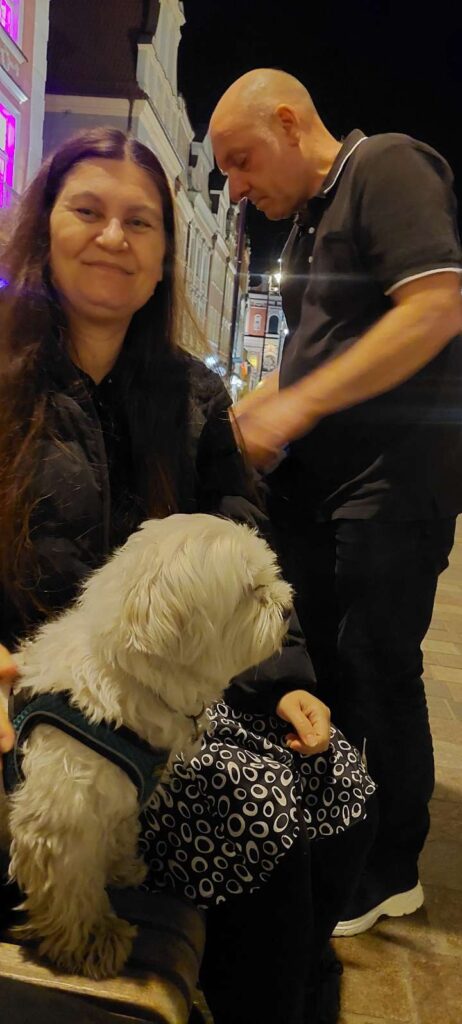
    A dog is sitting with a woman and a man stands in the background in Poznan main square late at night
    Bringing Sofus was the best decision – he made the trip much better – here we are in Poznan

    FAQ

    How much extra does it cost to travel Europe with a dog?

    For our two-month, three-person trip through Poland and Germany, we estimate the dog added $1,000–1,500 — almost none of it his fares. The cost is the itinerary a dog requires: no budget flights, longer rail journeys, sometimes an extra city, and a smaller, pricier pool of accommodation.

    How much do dogs cost on European trains?

    Almost nothing, in our experience: about €3.50 for one Polish PKP journey, and free on RegioJet and on our Deutsche Bahn-booked trains. The ticket is the cheapest part of the whole equation.

    Do pet-friendly apartments cost more?

    Not inherently — but “pets allowed” removed roughly 60% of Warsaw listings in our sample search, and a smaller pool means fewer options at your price point. Book early; the good-value dog-friendly places go first.

    Is Poland cheap to travel with a dog?

    Poland was our bargain: ~€4–5 Ubers, ~€57/night for a central dog-friendly apartment, cheap onboard train food. Germany ran at Danish prices — a €17 Uber and €132/night in Berlin — so budget the two countries very differently.

    Do I need cash in Poland and Germany?

    Practically, no — in two months exactly one shop refused our card. Carry a small amount anyway for tips and human moments.

    These are the headline numbers. The guide has the full money chapter — the booking tactics that lowered our rates, the accommodation trade-offs, every operator’s prices, and the complete honest budget — alongside the whole journey. €19, instant PDF plus a phone-friendly online version.
    Get the guide — €19

    Karen Svold Coates, author of EuroDogTravels

    Karen Svold Coates — M.Sc. Biology (Aarhus University), professional linguist with 11+ years in localization QA.

    Karen, Carl and Daniel travel Europe by train with Sofus, their 6.2 kg Coton de Tuléar, and publish real costs from their own receipts. Prices are from spring 2026 and will drift — treat them as orientation. Found something that’s changed? Tell us and we’ll fix it.

  • Krakow with a dog

    Krakow with a dog

    By Karen Svold Coates, M.Sc. Biology · First-hand: two weeks in Kraków with our dog, April 2026 · Last updated June 2026

    Kraków With a Dog: a First-Hand City Guide (2026)

    We spent two weeks in Kraków with Sofus, our 6.2 kg Coton de Tuléar — two apartments, one unforgettable evening walk, a vegan restaurant that welcomed him like a regular, and one day of careful planning so we could visit Auschwitz while he stayed home. Kraków turned out to be one of the best dog cities of our two-month journey through Poland and Germany: compact, walkable, generously green, and full of people who light up at a small white dog. Here’s the honest guide we wish we’d had — where to walk, where you’re welcome, the one big place dogs can’t go, and the practical details that made it work.

    The evening walk that beat everything else on our trip

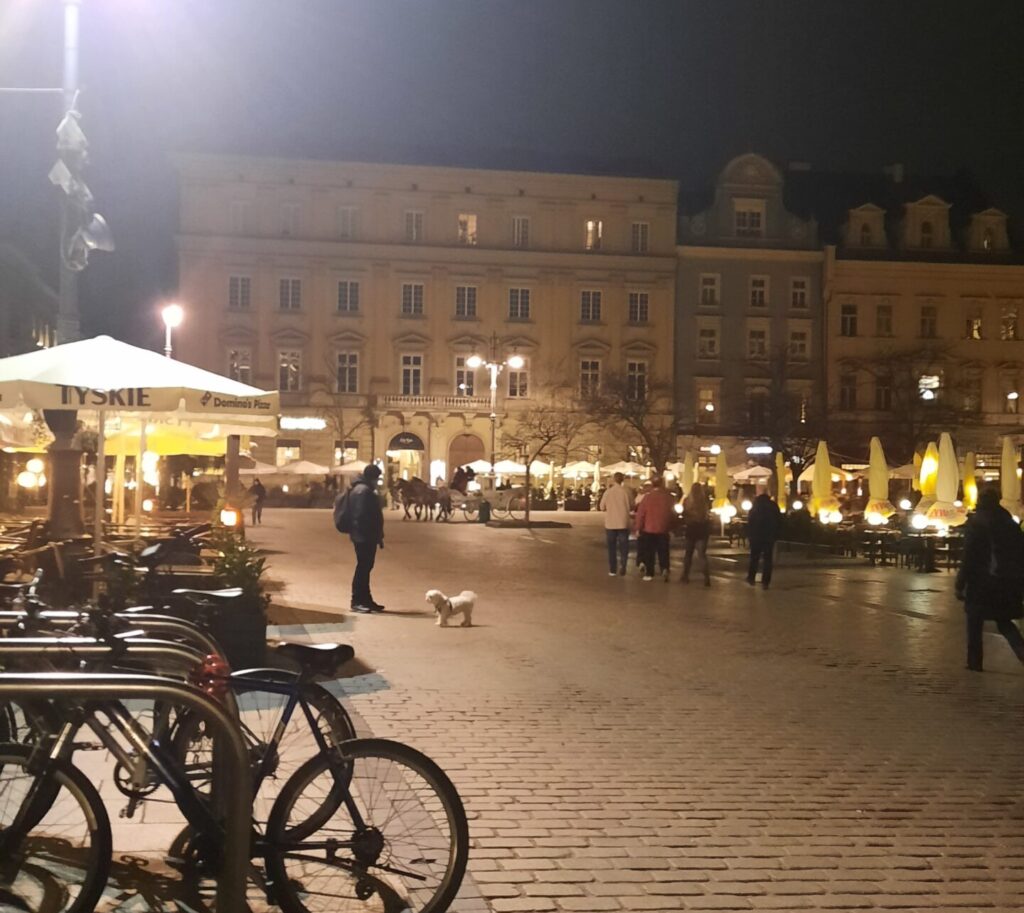
    From the old town through the Planty — the ring of park where the medieval walls once stood — into the Rynek Główny after dark. Europe’s largest medieval square, glowing and calm at night, was the single loveliest place we walked our dog anywhere.

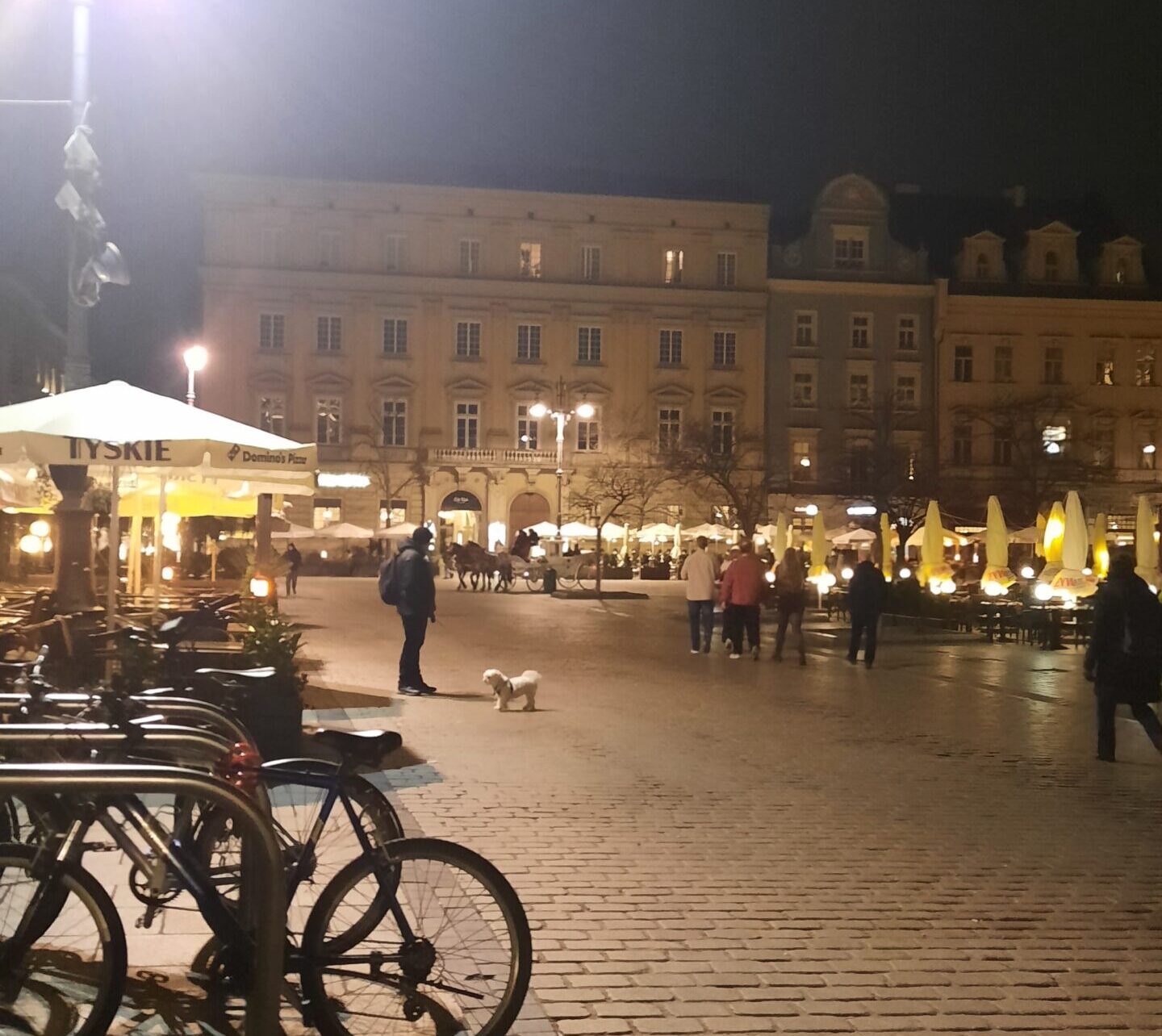
    dog walk in krakow old town square at night
    Sofus enjoyed the late night walks to the Old Town Square in Krakow – he met lots of horses and other dogs

    Almost every evening we did the same thing and never tired of it: up through the old town toward the main square, arriving after dark. On the way, a ritual pause on a bench in the Planty — the continuous green ring that encircles the old town, a quiet leafy hallway between the streets and the bright square ahead. Then out into the Rynek Główny at its vast, glowing, night-time best: a small white dog and three happy people in an enormous old space. Many nights we heard the hejnał — the live trumpet call from St Mary’s tower that breaks off abruptly mid-note, as it has for centuries. If you walk one route in Kraków with your dog, walk this one, and don’t skip the bench.

    The other direction: the river below Wawel

    The embankments along the Wisła are wide and open — the best leg-stretch in central Kraków, with Wawel Castle rising above the bank. Note: dogs aren’t allowed inside the Wawel castle complex itself, so the riverbank is the dog-owner’s version of the visit.

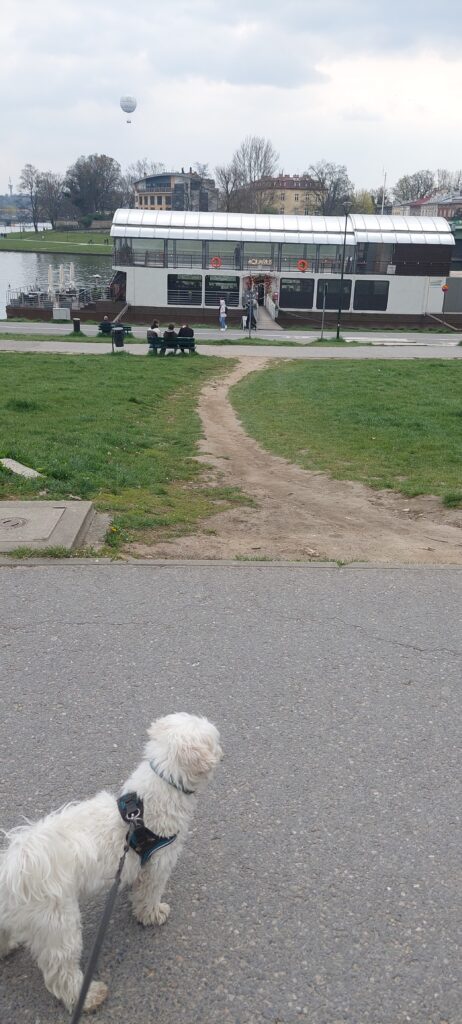
    dog walk to vistula river in Krakow
    One of the many great walks in Krakow – to the Visula River

    From our first apartment near the river, the opposite walk led down to the Wisła, where the broad embankments gave Sofus real room to move — a completely different mood from the enclosed old town. Wawel Castle towers above the water, and this is the honest workaround for dog owners: the castle complex doesn’t admit dogs, even just to walk the grounds, so admire it from the riverbank below, which is arguably the better view anyway. Between the square one way and the river the other, a central apartment gives you two good walks from a single door.

    Where Sofus was welcome: our tested places

    No Bones (vegan, Bracka 15, three minutes from the square) and Pijalnia Wódki i Piwa (Stolarska 5) both welcomed the dog inside without a second thought. The Caffè Nero Green cafés were our reliable dog-friendly chain across Poland.

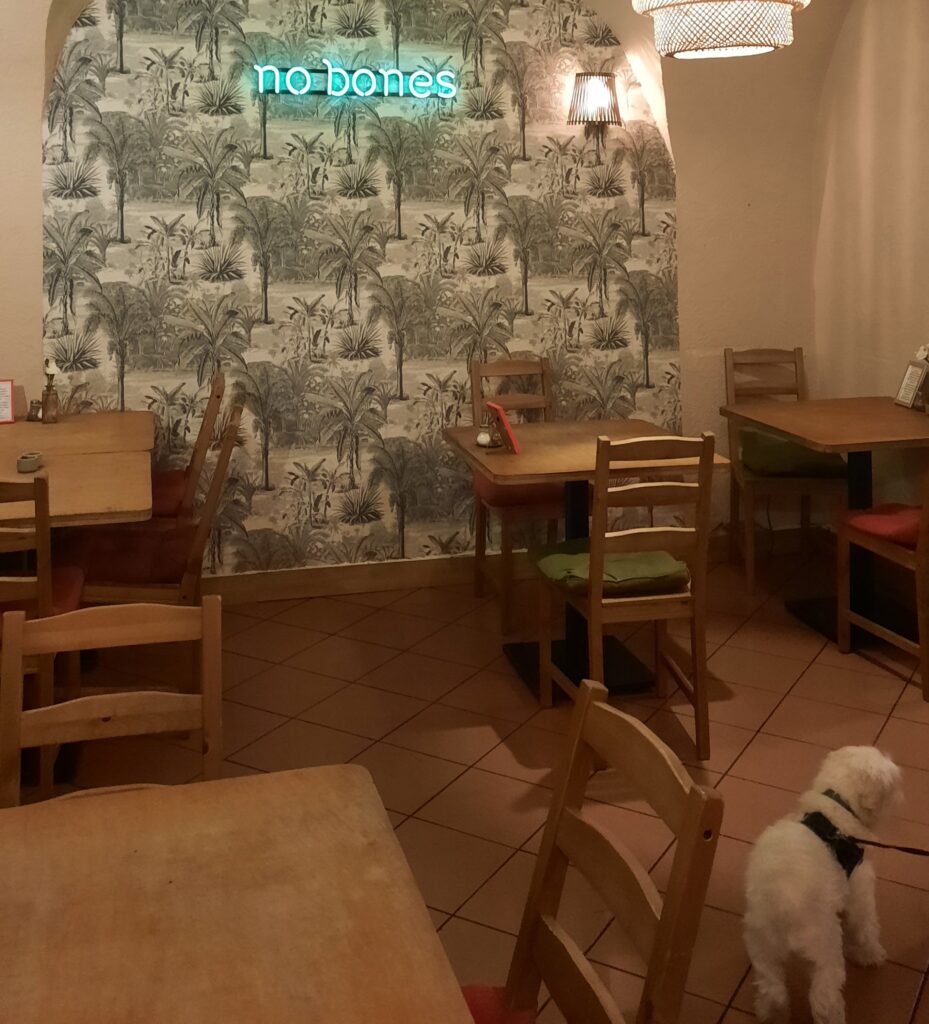
    Sofus the dog is standing inside the restaurant No Bones in Krakow.
    No Bones restaurant in Krakow was a great place to bring Sofus

    No Bones, at Bracka 15, resolved the eating question on our first evening: excellent vegan food, Sofus genuinely welcome, no fuss — and by dessert a British couple was petting him and swapping travel stories. Pijalnia Wódki i Piwa, at Stolarska 5 — the first bar at the entrance to pasaż Bielaka, the covered bar alleyway off the square — became our evening place for the whole stay: dog allowed in without a blink, excellent 1980s music, relaxed on weekdays. And across Poland, the Caffè Nero Green cafés reliably let Sofus inside and brought him water unprompted — a small piece of knowledge that quietly improved the entire trip.

    One honest warning: Saturday nights on the square

    Kraków is one of Europe’s major stag-party destinations. On weekend nights the square and its surroundings fill with loud, unpredictable crowds — we enjoyed the energy in small doses, but we didn’t take the dog.

    On weekdays, even our beloved Pijalnia was calm enough for conversation; on Saturdays the same streets belonged to British stag and hen parties. Nothing dangerous — just loud, boozy and unpredictable, which is not where a small dog wants to be. Do your square walk on a weekday evening, and leave the dog home on Saturday night.

    Kazimierz — worth a full afternoon

    Kraków’s Jewish quarter is walking distance from the old town: quieter, layered with history, and a completely different atmosphere to explore with a dog at street level.

    The synagogue visible in Schindler’s List still stands, and walking Kazimierz’s streets — especially after visiting Auschwitz — produces a different kind of stillness than the square. It’s an easy, rewarding afternoon on foot with a dog. (Schindler’s Factory, like Auschwitz, sells out well ahead — book early; we missed it and are going back.)

    The Auschwitz day: how we handled it with a dog

    Dogs can’t visit Auschwitz, so the real question is how long yours can stay alone. The free self-guided tickets mean a shorter absence (ours was seven hours door to door) than a full guided tour from Kraków, which can run ten.

    Auschwitz is the reason many people come to Kraków, and it deserves its own planning — we’ve written the ticket lessons in detail elsewhere, but the dog-specific part is this: the visit means leaving your dog alone, and the length depends on the format. A full guided tour from Kraków, with transport, can take up to ten hours. The free self-guided tickets (booked, like everything, at auschwitz.org — before you book your apartment, a lesson we learned the hard way) run at quieter hours and made our total absence about seven hours: train to Oświęcim, the visit, and home.

    Seven hours was within what we knew Sofus could manage — but only because we’d tested it, leaving him four to five hours a few times in Warsaw first. We left him with plenty of water, his familiar mat from the carrier, soft sleeping spots, and his toy. He was fine. Only you know your dog: test shorter absences first, and if ten hours is too long, the self-guided visit is a real alternative rather than a compromise.

    The practical details

    Stay as close to the old square as budget allows; book early if your stay spans two weekends; Uber Pet fills the gaps; and the train connections are excellent.

    Walking distance to the square transforms the daily rhythm with a dog — every outing becomes the lovely walk instead of a logistics exercise. Kraków weekends book out fast, so a stay spanning two weekends narrows the apartment field; start early. For everything beyond walking range we used Uber (Uber Pet where offered — message the driver about the dog either way), which in Poland cost so little it removed public transport from the equation entirely. And Kraków’s rail connections are excellent: we arrived from Warsaw and left for Poznań by train — the full story of the dog rules and prices on those journeys is in our first-hand guide to dogs on Polish trains.

    FAQ

    Is Kraków dog-friendly?

    In our two weeks’ experience, very. Restaurants and bars let our small dog inside without fuss, the old town is compact and walkable, the Planty ring and the Wisła embankments give real green space, and people were consistently warm toward him.

    Can I take my dog to Wawel Castle?

    No — dogs aren’t allowed in the Wawel castle complex, even the grounds. The best alternative is the wide Wisła riverbank directly below, which gives your dog space and you the castle view.

    Which Kraków restaurants and bars allow dogs?

    Our tested places: No Bones (vegan, Bracka 15) welcomed our dog inside, as did Pijalnia Wódki i Piwa (Stolarska 5). Caffè Nero Green cafés reliably allowed him in and brought water. Policies vary, so ask at the door — a small dog with a mat helps.

    What do I do with my dog when visiting Auschwitz?

    Dogs can’t visit, so plan the absence: a guided tour from Kraków can take up to ten hours; the free self-guided tickets meant about seven hours away for us. Test your dog with shorter absences first, and leave water, familiar bedding and a comfortable setup.

    Is the main square safe for dogs at night?

    On weekday evenings it was the loveliest walk of our whole trip — calm, glowing, unforgettable. On Friday and Saturday nights the stag-party crowds take over; we’d leave the dog at home then.

    Kraków was two weeks of a two-month journey. The full guide covers all of it — Warsaw, Kraków, Poznań and Berlin, five train operators, the flight, and the honest costs — from a family who actually did it. €19, instant PDF plus a phone-friendly online version.
    Get the guide — €19

    Karen Svold Coates, author of EuroDogTravels

    Karen Svold Coates — M.Sc. Biology (Aarhus University), professional linguist with 11+ years in localization QA.

    Karen, Carl and Daniel travel Europe by train with Sofus, their 6.2 kg Coton de Tuléar, and document every city firsthand. We stayed in Kraków in April 2026; venues and rules change — always check ahead. Found something that’s moved? Tell us and we’ll fix it.

  • Dogs on German Trains / Deutsche Bahn

    Dogs on German Trains / Deutsche Bahn

    By Karen Svold Coates, M.Sc. Biology · First-hand: two DB-booked journeys with our dog, spring 2026 · Last updated June 2026

    Taking a Dog on German Trains: Deutsche Bahn’s Confusing Rules, Explained First-Hand (2026)

    Deutsche Bahn’s dog rules are some of the most confusing in Europe — free for small dogs but not big ones, half-price tickets on some journeys and full-price on others, a booking system where a paid dog is entered as “Hund,” and a muzzle rule everyone asks about. We travelled through Germany with Sofus, our 6.2 kg Coton de Tuléar, on two trains booked at bahn.de — the EuroCity from Poznań to Berlin and the ComfortJet from Berlin towards Denmark — and in both cases the reality was far simpler than the rulebook: the dog travelled free, listed on the ticket, and nobody ever checked a muzzle. Here are the official rules untangled, and what actually happened.

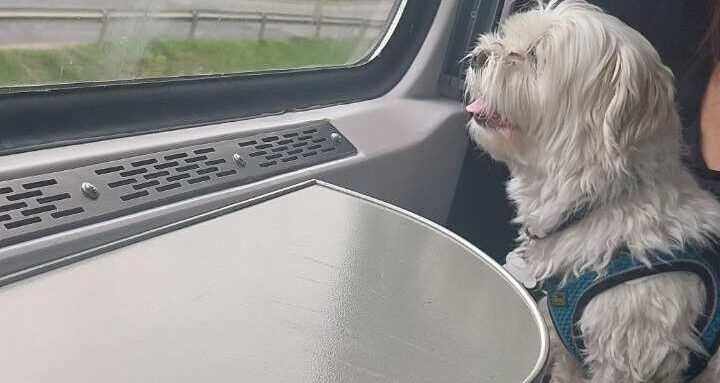
    A small white dog is looking out of the window on an German EC train to Berlin
    Sofus looks out of the window on the German EC train to Berlin.

    The small-dog rule: free, and simple

    A small dog — up to roughly the size of a house cat — travels free on Deutsche Bahn, officially in a closed carrier. On both our bahn.de bookings, Sofus was added to the ticket at no charge.

    This is the good news, and if your dog is small it’s most of what you need to know. When we booked at bahn.de, the dog was simply part of the booking — on the ComfortJet ticket he appeared as “1 Hund,” fare: nothing. The official framing is that small dogs travel free in a carrier; the practical reality on our journeys was that Sofus spent most of the time out of the bag, on the floor or a lap, and no conductor on either train raised an eyebrow. Bring the carrier — it’s your fallback if a conductor insists or a neighbour objects — but expect a relaxed reality.

    The big-dog rules: where it gets genuinely strange

    A dog larger than a cat needs a ticket: half-price on long-distance trains, but full adult price on many regional services, and a child’s ticket on cross-border journeys. Paid dog tickets often can’t be issued as mobile e-tickets.

    This is the part that fills forums with confusion, so here it is untangled. A larger dog (anything bigger than a house cat) pays: on long-distance ICE/IC/EC journeys the dog ticket is half the adult fare; on regional journeys it can be a full adult fare; on cross-border journeys the dog is booked with a child’s ticket. Stranger still, when booking online, a paid dog is entered with “Hund” in place of a passenger name — and DB has historically not issued mobile e-tickets for dogs, meaning tickets by post or from the station. It’s a system only a large bureaucracy could design. If you’re travelling with a big dog, our honest advice: book early, at a station or with time for postal delivery, and confirm the current process on bahn.de — it changes, and it’s the least transparent part of German dog travel.

    Two universal rules regardless of size: dogs travel on the floor, never on seats, and there are no seat reservations for dogs.

    What our journeys were actually like

    Two DB-booked trains through Germany: an empty six-seat compartment on the EuroCity from Poznań, and a calm half-empty ComfortJet from Berlin. Both times: dog free, out of the bag, completely uneventful.

    The EuroCity EC 46 from Poznań to Berlin Hauptbahnhof was, in the end, the easiest border we ever crossed. We’d booked four seats of a six-seat compartment at bahn.de and had the whole compartment to ourselves; a steward brought free juice and water and — with real kindness — kept his distance so as not to unsettle the small dog. At the Polish–German border, police walked the train and checked nothing: not our passports, not Sofus’s. The most-prepared-for moment of the trip passed us by entirely. Have the EU pet passport ready; expect not to need it.

    The ComfortJet from Berlin (our leg home towards Denmark) told the same story: dog printed on the ticket as “1 Hund,” free, two conductors — one German, one Danish — glancing at Sofus and asking nothing. We’ve written up that whole journey in our first-hand ComfortJet account.

    The muzzle question, honestly

    The official rule: a dog outside a carrier should be leashed and muzzled. Our experience across every German leg: Sofus never wore his, and no one ever checked. Carry one anyway.

    This is the question everyone asks, so here’s our unvarnished experience: on both German journeys, Sofus never wore his muzzle and no conductor ever mentioned it. Whether that’s because he’s six kilos of white fluff or because enforcement is simply relaxed for small dogs, we can’t say — and a larger dog may well be treated differently. The rule exists; the muzzle weighs nothing; carry it visibly and read the room. We’d never relax it around children or in a crowd, and if a conductor asks, on it goes without argument.

    Berlin public transport with a dog — the rules (and what we chose instead)

    On Berlin’s U-Bahn, S-Bahn, trams and buses: small dogs travel free in a carrier; larger dogs need a reduced-fare ticket plus leash and muzzle — and travel free with a day ticket. We’ll be honest: we used Uber instead.

    For completeness, the official Berlin (BVG) rules: a small dog up to cat size travels free in a closed carrier or bag; a larger dog needs a reduced-fare ticket and must be leashed and muzzled; dogs don’t sit on seats; and with a day ticket, a dog travels free. Honesty requires us to say we never tested this ourselves — in Berlin we walked and used Uber (which worked well with a dog, though at Berlin prices: about €17 for a ride that would have cost a handful of złoty in Poland). With a dog, luggage and a family, door-to-door was worth it to us. If you do use the U-Bahn with a small dog in a bag, the rules are on your side.

    Quick reference: your dog on German trains

    Your situationWhat applies
    Small dog (cat-sized) in a carrierFree, all trains
    Small dog out of the carrierOfficially: leash + muzzle. Our experience: relaxed, never checked
    Larger dog, long-distance (ICE/IC/EC)Half-price adult ticket, leash + muzzle
    Larger dog, regional trainsOften a full adult fare — check the region
    Larger dog, cross-borderBooked with a child’s ticket
    Any dogFloor only, no seats, no seat reservations for dogs
    Berlin U-Bahn/S-BahnSmall dog in carrier free; larger dog reduced fare + muzzle; free with day ticket

    Rules current as of spring 2026 and genuinely subject to change — always confirm at bahn.de when you book.

    Our practical tips for German trains with a dog

    Book at bahn.de and add the dog during booking so it’s on the ticket. If you can, book seats in a compartment — off-peak you may get it to yourselves, which transforms the journey. Lay your carrier’s base mat on the floor: the dog recognises its own scent and settles immediately (the trick that improved every train we took). Walk the dog properly before boarding — German long-distance legs are long and stops are short. And carry the muzzle and the EU pet passport, expecting to need neither.

    FAQ

    Do dogs travel free on Deutsche Bahn?

    Small dogs — up to about the size of a house cat — travel free, officially in a closed carrier. Larger dogs need a ticket: half-price on long-distance trains, often full adult fare on regional trains, and a child’s ticket on cross-border journeys.

    Do dogs need a muzzle on German trains?

    Officially, a dog outside a carrier should be leashed and muzzled. In our experience with a small dog, it was never checked on any German train — but carry one, keep it visible, and use it if asked or in crowds.

    How do I book a dog ticket on bahn.de?

    A small dog is added free during booking. A paid (larger) dog is entered with “Hund” in place of a passenger name — and paid dog tickets often can’t be issued as mobile e-tickets, so allow time for station purchase or postal delivery.

    Can my dog sit on the seat?

    No — dogs travel on the floor on German trains, never on seats, and no seat reservations are made for dogs.

    Was the Poland–Germany border crossing difficult with a dog?

    For us, the opposite: police walked the train and checked nothing — no human passports, no pet passport. Carry the EU pet passport ready, and expect a non-event.

    Germany was one half of a two-month journey. The full guide covers all of it — five train operators, the flight, three cities, and the honest costs — from a family who actually did it. €19, instant PDF plus a phone-friendly online version.
    Get the guide — €19

    Karen Svold Coates, author of EuroDogTravels

    Karen Svold Coates — M.Sc. Biology (Aarhus University), professional linguist with 11+ years in localization QA.

    Karen, Carl and Daniel travel Europe by train with Sofus, their 6.2 kg Coton de Tuléar, and document every route firsthand. Our German journeys were made in spring 2026; rules and fares change — always confirm at bahn.de before you travel. Found something that’s moved? Tell us and we’ll fix it.

    Official sources

    Rules change — always check the current official pages before you book:

  • Dog on Polish Trains: RegioJet vs PKP Intercity

    Dog on Polish Trains: RegioJet vs PKP Intercity

    By Karen Svold Coates, M.Sc. Biology · First-hand: both operators ridden with our dog, spring 2026 · Last updated June 2026

    Dog on Polish Trains: RegioJet vs PKP Intercity, Compared First-Hand (2026)

    Sofus the dog sitting on his owner's lap in a RegioJet Business class compartment in Poland.
    Sofus travelling first-class on RegioJet, Warsaw to Kraków.

    Poland is one of the easier countries in Europe to travel by train with a small dog — no weight limit for a dog in a carrier, no forms, just a ticket and a leash. We crossed the country with Sofus, our 6.2 kg Coton de Tuléar, on two operators: RegioJet Business class from Warsaw to Kraków, and PKP Intercity first class from Kraków to Poznań. They gave us a direct comparison, and the honest verdict is that both are good and one is better. Here’s how each handled a dog, what they cost, the boarding realities, and the small trick that transformed every journey after.

    Quick comparison

    RegioJet carried the dog free and included food and drink; PKP Intercity charged a small dog ticket and shared compartments with strangers. RegioJet was the more comfortable experience — but its domestic Polish routes have since closed.

    RegioJet BusinessPKP Intercity 1st
    Route we rodeWarsaw → KrakówKraków → Poznań
    Dog fareFree~15.20 zł (~€3.50)
    Seating4-seat compartment (buy all 4)6-seat compartment (shared)
    IncludedJuice, water, coffee
    Onboard pricesVery cheap
    Muzzle ruleRead the roomRequired, rarely enforced
    Book atregiojet.comintercity.pl

    Prices and rules are from spring 2026 — always confirm current details when you book.

    RegioJet Business class: Warsaw to Kraków

    A private four-seat compartment, the dog free, and juice, water and coffee brought to us throughout — for about €32 a head on a near-three-hour journey. The comfort was almost improbable for the price.

    We booked at regiojet.com two weeks ahead. Business class comes in compartments of four seats; we were three adults, and on advice we bought the fourth seat too — so we had the whole compartment to ourselves and Sofus. It was one of the better decisions of the trip. Four seats came to €130.90 total. The dog travelled free.

    What we hadn’t expected was the service: fruit juice and water on boarding, then several cups of coffee brought to the compartment during the journey — included, not sold. Onboard snacks were priced like a Polish supermarket, not a Danish train (a kombucha was a couple of złoty). The seats were wide and properly reclining, the windows large, the red upholstery and wood panelling genuinely comfortable. Sofus spent most of the journey on a lap watching the flat early-April countryside, calm from the moment we settled.

    PKP Intercity first class: Kraków to Poznań

    The long haul — 420 km, nearly five hours — with a small dog ticket and six-seat compartments you share with strangers. That sharing turned out to be the best part of the whole trip.

    Booked at intercity.pl three days ahead: four first-class tickets plus a dog ticket (about €3.50 — PKP charges for a dog where RegioJet doesn’t), roughly €96 total for four seats and Sofus, on IC 3812 ‘Szkuner’, Kraków 12:40 to Poznań 17:29. First class here is six-seat compartments (three facing three), and with four seats we shared with whoever else booked. We’d feared that; we were wrong to.

    Over the journey a slow rotation of strangers came and went — and at one stop a Polish woman in her late fifties saw Sofus and lit up, showing us phone videos of her own dog with her grandchild. A quiet young Mexican traveller joined in. Suddenly the compartment was three Danes, a South African, a Mexican and a Polish grandmother, all talking across languages about dogs and travel, with a small white dog working the room as the star. We boarded as strangers and got off almost as friends. A dog in a train compartment, we learned, is a conversation that hasn’t started yet.

    The boarding is the hard part — on both

    The journeys were calm; the getting-on was not. Crowded platforms at Warsaw and narrow corridors at Kraków (reached through a shopping mall and escalators) were the real challenge — made worse by heavy luggage.

    At Warsaw Central the platform was crowded and our RegioJet ran 40 minutes late (a knock-on delay), so Sofus was in his carrier a long time — longer than the journey. We held the carrier close, above ankle height, out of the flow of hurrying travellers. At Kraków Główny, which sits under the Galeria Krakowska mall, boarding meant a long walk and escalators with all our bags, then a first-class corridor so narrow we had to reverse — luggage and all — to let other passengers pass. The lesson we kept relearning: travel light. Every extra kilo becomes a problem in a train corridor.

    Karen standing with Sofus the dog and luggage on the platform at Warsaw Central station.
    Boarding at Warsaw Central – dog, carrier and bags. The lesson we kept relearning: travel light.

    The mat trick that changed everything

    Lift the padded mat out of your carrier and lay it on the compartment floor. The dog recognises its own scent, claims the spot, and settles instantly — instead of negotiating laps and seats for hours.

    We discovered this on the PKP journey and used it on every train after. The Trixie carrier’s base mat lifts out in seconds; laid on the floor between the seats, it became Sofus’s own patch of territory on an unfamiliar floor. He lay down and relaxed for the rest of the journey. It costs nothing, takes ten seconds, and travels inside the bag you’re already carrying. If your carrier has no removable mat, pack a small blanket that lives in the carrier between trips so it carries the right smell.

    The things that caught us out

    One bout of travel sickness in two months, on the leg we were least prepared for. Pack a wipe kit, and limit your dog’s food before a long journey.

    On the PKP leg Sofus was sick — the only time in two months, of course with an audience — and we had two paper napkins to deal with it. Bring babywipes and a zip-lock bag for the used ones; it weighs nothing. Afterwards we learned to limit his food in the hours before a long journey (enough that he wasn’t hungry, not so much there was a lot to bring back up), which helps with motion sickness. If your dog is genuinely prone to it, ask your vet about dog anti-nausea options before you travel — a far easier conversation to have in the clinic than to wish you’d had somewhere between Kraków and Poznań.

    The muzzle question

    PKP’s rules require a muzzle for a dog outside its carrier; in practice it was never enforced for us. Bring one, keep it visible, and read the room.

    Sofus started the PKP journey wearing his muzzle; at some point it slipped off and we didn’t put it back. He was out of the bag for essentially the whole journey and no conductor said a word — whether because he’s six kilos of white fluff or because the rule is loosely enforced, we can’t say. Our advice stays the same: carry the muzzle, have it visible, and never relax it around children or in a crowd.

    An important note on RegioJet’s Polish routes

    RegioJet ended its domestic Polish services on 3 May 2026 — so the Warsaw–Kraków route we rode is gone. Its international routes from Poland still run, and we recommend them.

    We travelled on 8 April 2026 and were, without knowing it, among the last to make that domestic journey with RegioJet. The Warsaw–Kraków route no longer appears on their site. What you can still book are RegioJet’s international routes — Prague–Ostrava–Warsaw and Prague–Ostrava–Kraków–Przemyśl, plus a wide Central European network. On the strength of what we experienced, we’d travel with them again without hesitation.

    The verdict

    Both operators made travelling Poland with a dog easy and pleasant. RegioJet was the better experience on nearly every measure — more comfortable seats, included food and drink, cheaper snacks, the dog free, and the option to buy a private compartment. PKP Intercity charged a small dog fare and meant sharing a compartment — which, against our expectations, gave us the warmest hour of the whole trip. Book RegioJet for the international routes they still serve; book PKP Intercity for everything within Poland, and don’t dread the shared compartment.

    FAQ

    Do dogs travel free on Polish trains?

    It depends on the operator. On RegioJet, our small dog in a carrier travelled free. PKP Intercity charges a small dog ticket — about 15.20 zł (€3.50), added during online booking.

    Is there a weight limit for a dog on Polish trains?

    For a small dog travelling in a carrier, there’s no weight limit to worry about — a big advantage of the train over flying. Larger dogs out of a carrier must be leashed and, per the rules, muzzled.

    Do I need a muzzle for my dog on PKP Intercity?

    The rules require a muzzle for a dog outside its carrier. In our experience it wasn’t enforced for a small dog, but carry one and keep it visible.

    How much does a first-class ticket with a dog cost in Poland?

    Our four PKP Intercity first-class tickets plus the dog fare, Kraków to Poznań (420 km, nearly five hours), came to about €96 total — remarkable value. RegioJet Business Warsaw to Kraków was about €32 a head with the dog free.

    Can I still book RegioJet in Poland?

    RegioJet ended domestic Polish routes on 3 May 2026, so Warsaw–Kraków is gone. Its international routes from Poland (via Prague and Ostrava) still run and are bookable at regiojet.com.

    These are two legs of a two-month journey. The full guide covers all of it — five train operators, the flight, three cities, and the honest costs — from a family who actually did it. €19, instant PDF plus a phone-friendly online version.
    Get the guide — €19

    Karen Svold Coates, author of EuroDogTravels

    Karen Svold Coates — M.Sc. Biology (Aarhus University), professional linguist with 11+ years in localization QA.

    Karen, Carl and Daniel travel Europe by train with Sofus, their 6.2 kg Coton de Tuléar, and document every route firsthand. Both journeys were made in spring 2026; routes and rules change — always confirm before you travel. Found something that’s moved? Tell us and we’ll fix it.