Category: Articles

  • ComfortJet with a dog

    ComfortJet with a dog

    By Karen Svold Coates, M.Sc. Biology · Verified in person, spring 2026 · Last updated June 2026

    Taking a Dog on the ComfortJet, Berlin to Denmark: the First-Hand Account (2026)

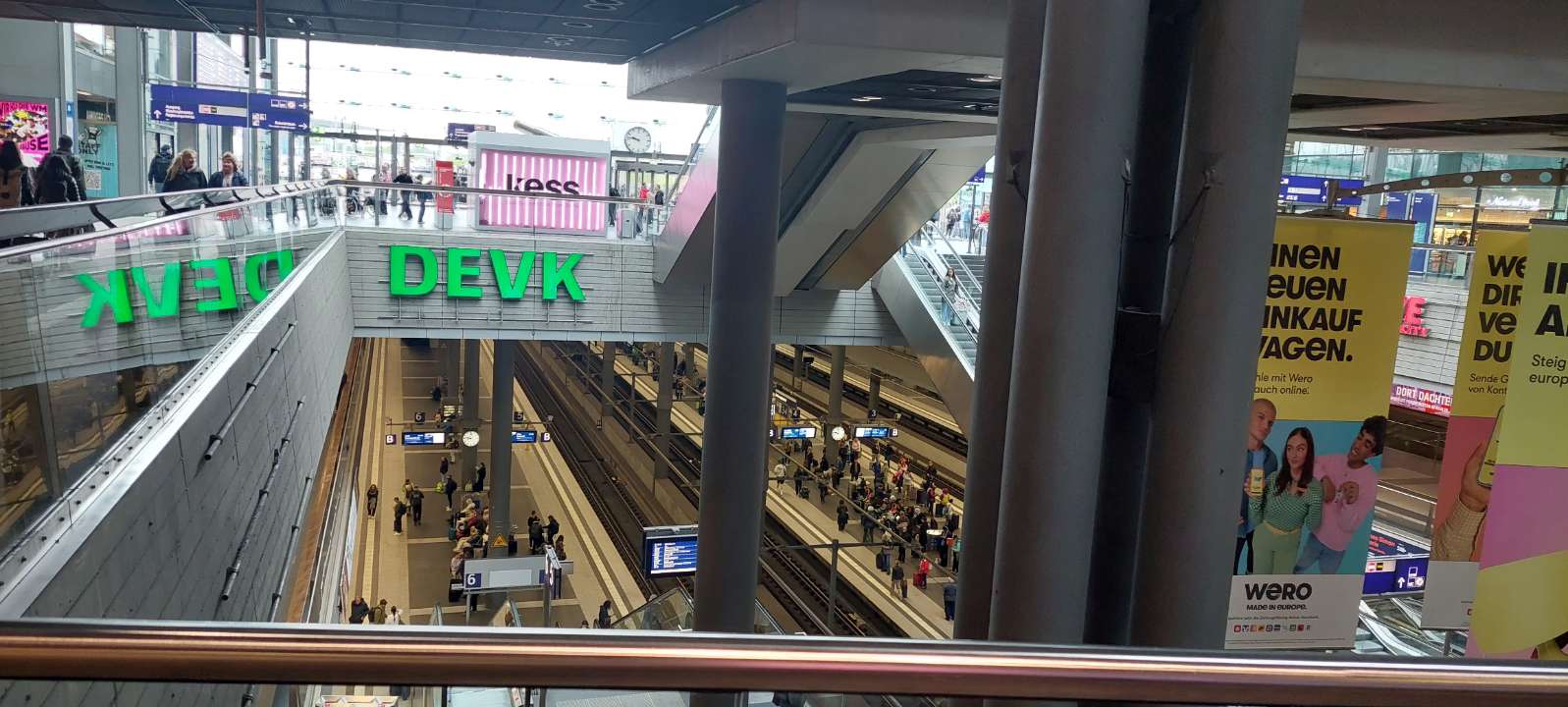
    Berlin Hauptbahnhof view of the train track below before we got on the train – easy to navigate

    The ComfortJet is Czech Railways’ new flagship — a direct international train running Prague–Dresden–Berlin–Hamburg–Copenhagen — and you can take a dog on it. We rode RJ 384 from Berlin Hauptbahnhof to Odense in spring 2026, on a service that had existed for six days, with Sofus, our 6.2 kg Coton de Tuléar. As far as we know, this is the first account anywhere of what it’s actually like to travel with a dog on the ComfortJet. Below: how we booked, the free dog ticket, the muzzle reality, the surprise hour in Hamburg, and the seven calm hours in between.

    Booking — and the dog travels free

    On our cross-border Sparpreis booking, three people came to €311, booked about a week ahead — and the dog was free, simply printed on the ticket as “1 Hund.”

    The dog was added with no fuss and no fare — listed on the booking like the most normal thing in the world. Two catches are worth knowing: a Sparpreis (saver) fare can’t be cancelled, and on this cross-border booking you can’t choose your seats in advance. We booked through the German railway; the ComfortJet is a Czech Railways service, and the through-ticketing across operators worked smoothly.

    The journey — eight hours, and it runs on ordinary railway time

    RJ 384 from Berlin to Odense is scheduled at nearly eight hours — the longest single train of our trip — and even this gleaming new flagship ran a little late.

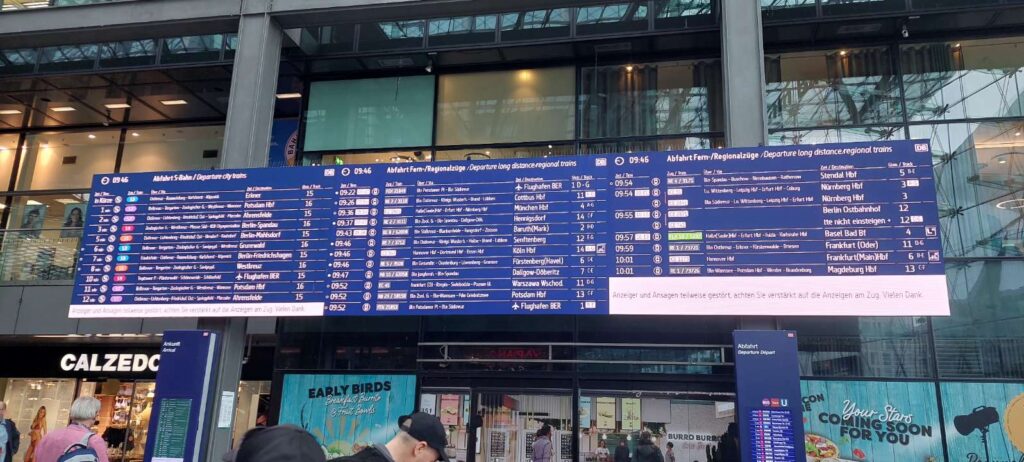
    Large infoboard of train departures in Berlin Hauptbahnhof – our departure was 16 minutes delayed

    Our 10:38 departure became 10:54. Sixteen minutes is nothing over eight hours, but it’s worth building a little slack into any onward connection. Berlin Hauptbahnhof itself is huge but easy — a glass escalator runs straight down to the platform thirty metres inside the door.

    Seven calm hours — and the mat trick

    Lay your carrier’s base mat on the floor by your seat: the dog recognises its own scent and settles instantly. Keep the harness on and leash in hand at all times, even while the dog sleeps.

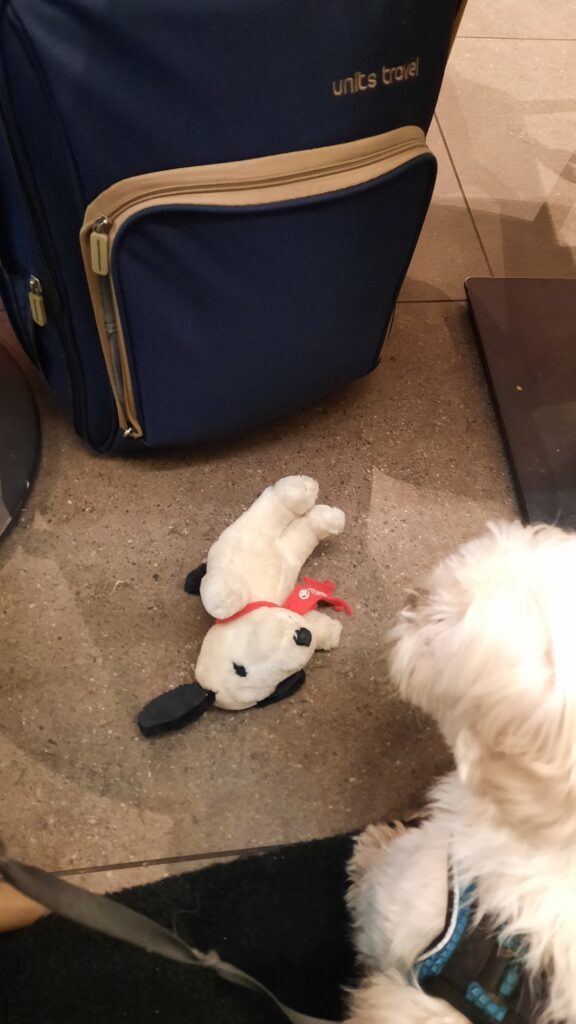
    The mat from the bag comes out so Sofus the dog can rest on it in train stations and in the train.
    The mat from Sofus’ carrier comes out so that he can use it is a “dog basket” – a familiar place to rest

    The train was only half full and nobody claimed the seats beside us, so we each had two seats with room on the floor between us. Out came the mat from the base of Sofus’s carrier — the trick that carried us across half of Europe — and he settled on his own patch of territory and slept for most of the journey. Harness on, leash in hand, always: that’s the rule on every train, even a sleeping dog.

    The muzzle reality

    Germany expects a muzzle on a dog travelling outside a carrier; in our experience it was never checked — but the rule exists, so carry it and treat any relaxation as your responsibility.

    Two conductors, one German and one Danish, each glanced at Sofus, glanced at the ticket, and asked nothing. It’s the same lesson Poland taught us: the rule exists, enforcement varies, and you should carry the muzzle anyway. We’d never relax it around children or in a crowd.

    The Hamburg hour — a toilet stop in disguise

    In its first weeks the ComfortJet ran a diversion with a long scheduled stop in Hamburg — which happened to solve the toilet question on an eight-hour day.

    The train stood still in Hamburg for a full hour, and Carl simply took Sofus off for a wee halfway through the longest train day of the trip. The reason: the regular Berlin–Hamburg line was under reconstruction until mid-June 2026, so the trains went the long way round via Stendal, Uelzen and Lüneburg, with a long Hamburg stop. From 14 June 2026 the route returned to normal — so that built-in break may no longer apply. On a long train day, plan your dog’s toilet timing around the actual stops, not the diversion.

    The restaurant car

    Onboard food was pricey — about 90 DKK for a dry sandwich — so bring your own for a long leg.

    Compared with RegioJet in Poland, where excellent food came to the seat for very little, the ComfortJet’s restaurant car felt expensive. Homemade sandwiches won the day, as they usually do.

    FAQ

    Can you take a dog on the ComfortJet?

    Yes. On our spring-2026 Sparpreis booking the dog travelled free, listed on the ticket as “1 Hund.” Keep the dog on a harness and leash, with a muzzle carried for the German leg.

    How much does a dog cost on the ComfortJet?

    On our cross-border booking the dog was free. Fares and pet rules vary by booking and operator, so confirm when you book.

    Is there a toilet stop for the dog?

    In early 2026 a diversion gave a long Hamburg stop, ideal for a wee — but that ended on 14 June 2026. On a normal run, plan around the scheduled stops on the nearly eight-hour journey.

    Do you need a muzzle for a dog on German trains?

    Germany expects a muzzle for a dog outside a carrier. In our experience it wasn’t checked, but carry it and use it as required.

    The ComfortJet was the last leg of a two-month journey. The full guide covers all of it — five train operators, the flight, three cities, and the honest costs. €19, instant PDF plus a phone-friendly online version.

    Get the guide — €19

    Karen Svold Coates, author of EuroDogTravels

    Karen Svold Coates — M.Sc. Biology (Aarhus University), professional linguist with 11+ years in localization QA.

    Karen, Carl and Daniel travel Europe by train with Sofus, their 6.2 kg Coton de Tuléar, and document every route firsthand. This journey was made in spring 2026; routes and rules change — always confirm before you travel. Found something that’s moved? Tell us and we’ll fix it.

    By Karen Svold Coates, M.Sc. Biology · Verified in person, spring 2026 · Last updated June 2026

  • Cabin Dog by Airline: Carrier Sizes & the 8 kg Rule, Compared (2026)

    Cabin Dog by Airline: Carrier Sizes & the 8 kg Rule, Compared (2026)

    By Karen Svold Coates, M.Sc. Biology · Verified in person, spring 2026 · Last updated June 2026

    Cabin Dog by Airline: Carrier Sizes, the 8 kg Rule & How to Choose the Bag (2026 Comparison)

    Almost every European airline caps a cabin dog at 8 kg combined — dog, carrier and contents — but the carrier size each allows varies a lot: from SAS’s small 40×25×23 cm box up to the 55×40×23 cm allowed by the Lufthansa Group, airBaltic and Finnair. We researched these limits while planning a real trip across Europe with Sofus, our 6.2 kg Coton de Tuléar, and bought two wrong carriers before we found the right one. Below is the comparison table we wish we’d had, the 8 kg rule explained, the carrier rule most websites bury, and how to choose a bag that fits both the airline and your dog.

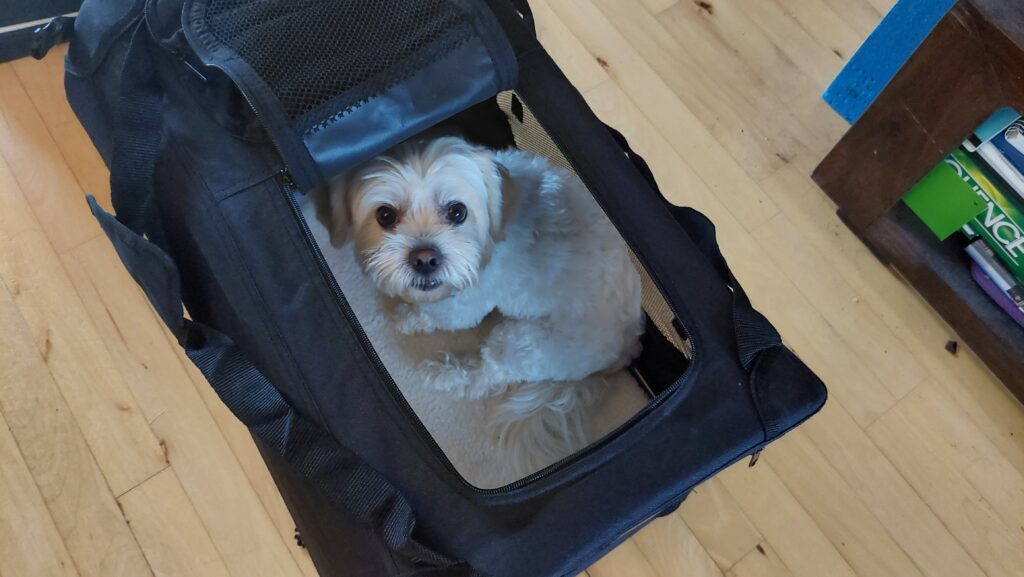
    Sofus is a 6.2 kg dog. He is sitting in a bag that is to big to take on the plane.
    Sofus enjoys all the space in this big bag, but it is too big to take on a flight.

    Cabin dogs by airline — the comparison table

    Most airlines share an 8 kg combined limit, but split into two carrier-size camps: a smaller box (SAS, Norwegian, KLM, Air France) and a larger 55×40×23 cm box (Lufthansa Group, airBaltic, Finnair).

    Verified by us while planning Copenhagen–Warsaw, spring 2026:

    AirlineMax carrierWeightNotes
    SAS40×25×23 cm8 kgSmaller bag
    Norwegian43×31×20 cm8 kgLonger, lower than SAS
    KLM46×28×24 cm8 kgNot in Premium/Business long-haul
    Air France46×28×24 cm8 kgShares KLM policy
    LOT Polish55×40×20 cm (Boeing)8 kg totalLarger box only if a Boeing operates
    Lufthansa55×40×23 cm8 kg totalRegister pet ≥72 hrs ahead
    Swiss55×40×23 cm8 kg totalLufthansa Group
    Austrian55×40×23 cm8 kg totalMust phone to add the pet
    Brussels55×40×23 cm8 kg totalLufthansa Group
    Eurowings55×40×23 cm8 kg total
    airBaltic55×40×23 cm8 kg totalAdvance booking required
    Finnair55×40×23 cm8 kg totalSmaller on Norra-operated flights

    Always confirm current limits with the airline before booking — these change, and we last checked them in spring 2026.

    The 8 kg rule — and why the bag eats into it

    The hard ceiling for almost every airline is 8 kg for dog, carrier and contents combined — and a light carrier already uses up a chunk of it.

    A 6.2 kg dog leaves under 1.8 kg for the bag and anything inside. That’s why weight, not temperament, decides whether cabin flying is even possible. Weigh your dog on your vet’s clinical scales, not bathroom scales. Sofus flew at 6.2 kg; a couple of years earlier he was about 7.5 kg, and at that weight we simply could not have flown with him — on our vet’s advice he lost the extra weight healthily first.

    The carrier rule most websites bury

    Your dog must be able to stand up, turn around and lie down naturally inside the carrier. It’s a condition of carriage, and it’s what gets dogs turned away at the gate.

    Maximum dimensions are easy to find; this rule isn’t stated prominently enough. Measure your dog nose to base of tail and add at least 10 cm — that’s your minimum bag length. Measure shoulder height standing and add at least 8 cm — your minimum height. Do this before buying anything.

    The two wrong bags we bought first

    We bought a too-small carrier (he fit, but couldn’t turn around) before settling on a light, larger Trixie bag sized for the bigger airline allowance.

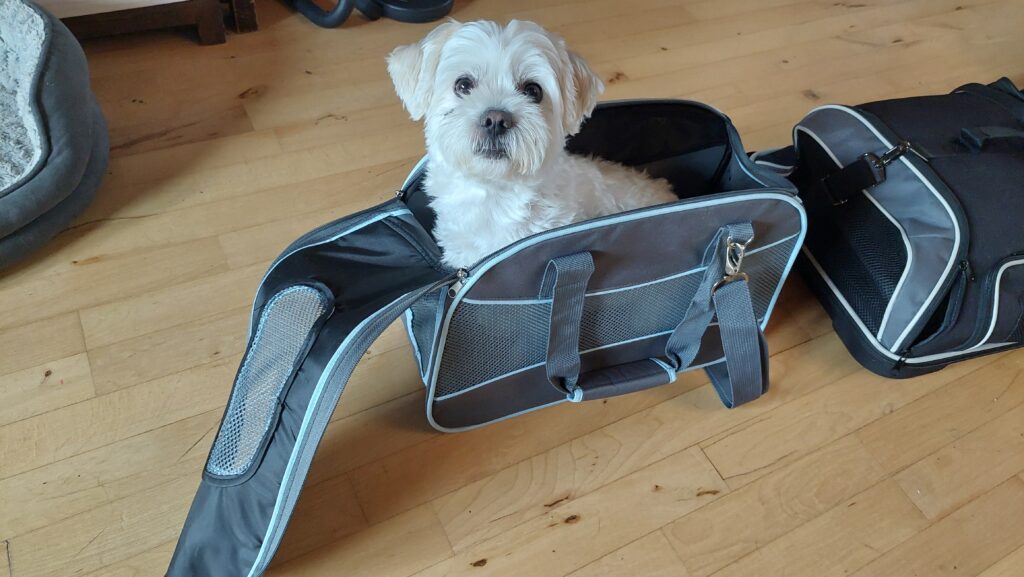
    Maltese dog sitting in a Trixie bag that is too small for him
    Sofus in the small Trixie bag – technically he fits, but he couldn’t turn around

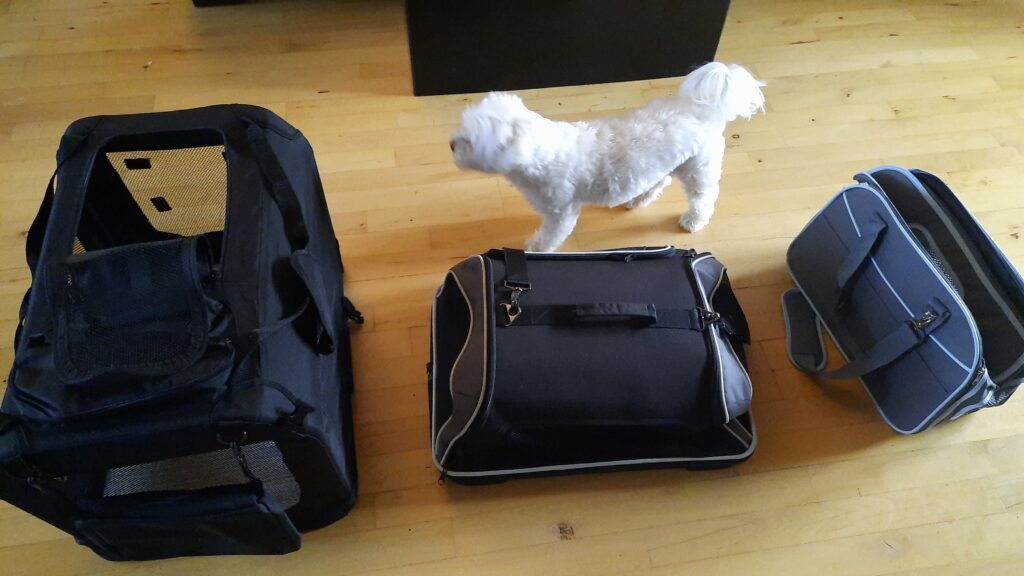
    Our first instinct was the cautious one — the smaller bag that fits every airline, including the restrictive ones. Sofus fit technically, but couldn’t turn around, which fails the condition above. The bag that worked was a Trixie Airline Boarding Carrier (55×40×20 cm): light, with a padded waterproof base and mesh on multiple sides. With airlines like LOT, the catch is that the larger allowance can depend on the aircraft type — so a larger bag is sometimes a calculated bet. Read our LOT cabin flight account for how that gamble played out.

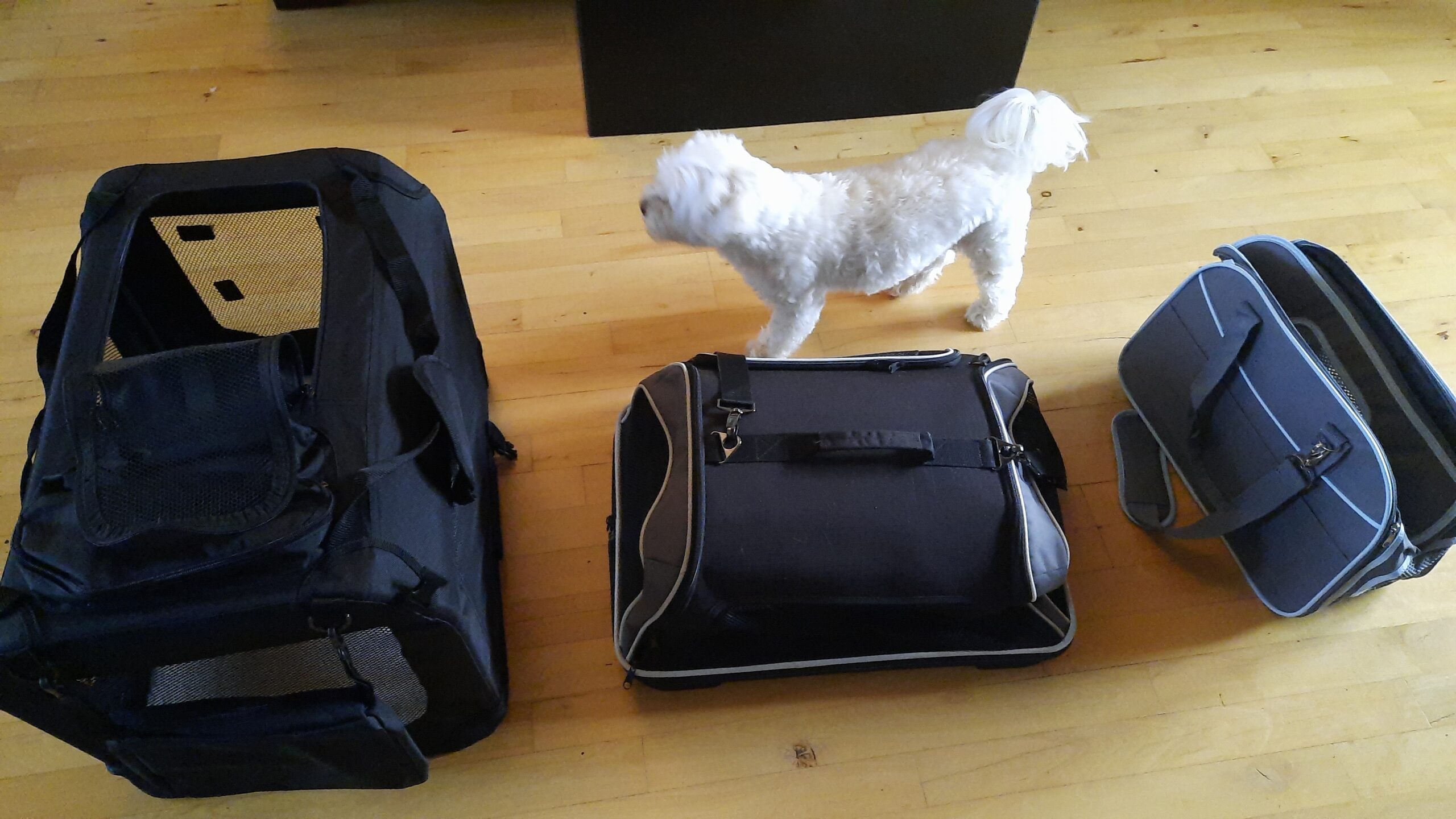
    Sofus the dog stands next to three bags. One is to big. One is to small. The Trixie Airline Boarding Carrier in the middle was perfect for him.
    The Trixie Airline Boarding Carrier in the middle was perfect for Sofus – he could turn around in it

    Big dog? The 2026 landscape

    If your dog is over roughly 6 kg, the train is usually the calmer choice — but a few new in-cabin options for larger dogs are emerging in 2026.

    The 8 kg wall is starting to crack: from summer 2026 ITA Airways allows dogs up to about 30 kg in the cabin on domestic Italian flights, and pet-jet services like Bark Air and K9 Jets fly any size in-cabin from cities including Berlin, Stockholm, London and Paris — but at thousands per seat. For most people with a larger dog, the honest 2026 reality is still the hold (which we were never willing to use), or another way entirely: train, ferry or car. That’s why our whole guide is built around the train.

    FAQ

    Which airlines allow the biggest cabin dog carrier in Europe?

    The Lufthansa Group (Lufthansa, Swiss, Austrian, Brussels, Eurowings) plus airBaltic and Finnair allow up to 55×40×23 cm. SAS, Norwegian, KLM and Air France use smaller boxes.

    What’s the weight limit for a dog in the cabin?

    Almost universally 8 kg combined — dog, carrier and contents. A light carrier already eats into that, so a dog much over 6 kg is borderline.

    What size carrier do I need?

    One that lets your dog stand, turn around and lie down — and fits the airline’s box. Dog length nose-to-tail plus 10 cm, shoulder height plus 8 cm, as minimums.

    Can a big dog fly in the cabin?

    Rarely in 2026, but it’s changing: ITA Airways (domestic Italy, up to ~30 kg) and expensive pet-jet services are early exceptions. Otherwise it’s the hold, or train/ferry/car.

    The full guide covers the carrier decisions in detail, plus five train operators, three cities, and the honest costs of a two-month trip with a small dog. €19, instant PDF plus a phone-friendly online version.
    Get the guide — €19

    Karen Svold Coates, author of EuroDogTravels

    Karen Svold Coates — M.Sc. Biology (Aarhus University), professional linguist with 11+ years in localization QA.

    Karen, Carl and Daniel travel Europe by train with Sofus, their 6.2 kg Coton de Tuléar, and document every route firsthand. Airline limits were checked in spring 2026 and change often — always confirm with the airline before booking. Found something that’s moved? Tell us and we’ll fix it.

  • Flying With a Dog in the Cabin on LOT Polish Airlines

    Flying With a Dog in the Cabin on LOT Polish Airlines

    By Karen Svold Coates, M.Sc. Biology · Verified in person, spring 2026 · Last updated June 2026

    Flying With a Dog in the Cabin on LOT Polish Airlines: the Aircraft-Type Trap, the 8 kg Rule & What It’s Really Like (Tested 2026)

    Flying a dog on LOT Polish Airlines is possible if the combined weight of dog, carrier and contents is 8 kg or under — but the carrier size you’re allowed depends entirely on which aircraft operates your flight, and LOT can’t always tell you in advance. On a Boeing B787 or B737 the limit is 55×40×20 cm; on an Embraer it drops to 45×30×20 cm.

    We flew Copenhagen–Warsaw in spring 2026 with Sofus, our 6.2 kg Coton de Tuléar, and that aircraft-type gamble was the single hardest decision of the trip. Below: how the carrier trap works, exactly what happens at check-in and security, the seat restriction nobody mentions, and the descent that caught us off guard.

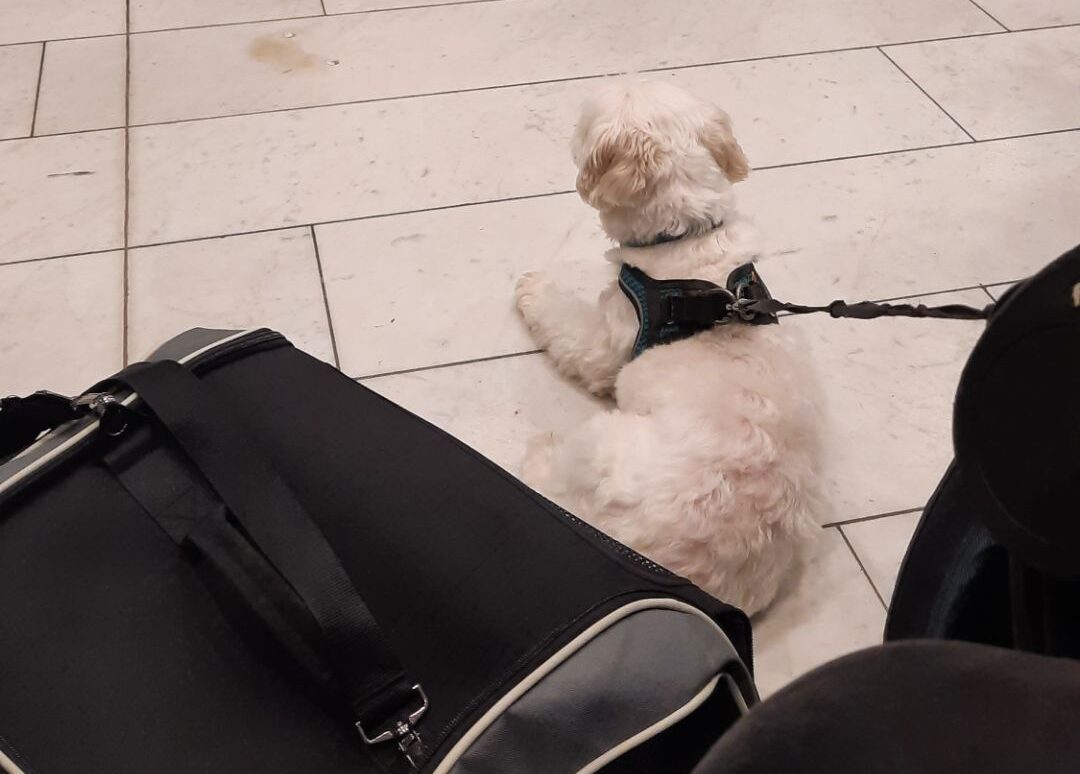
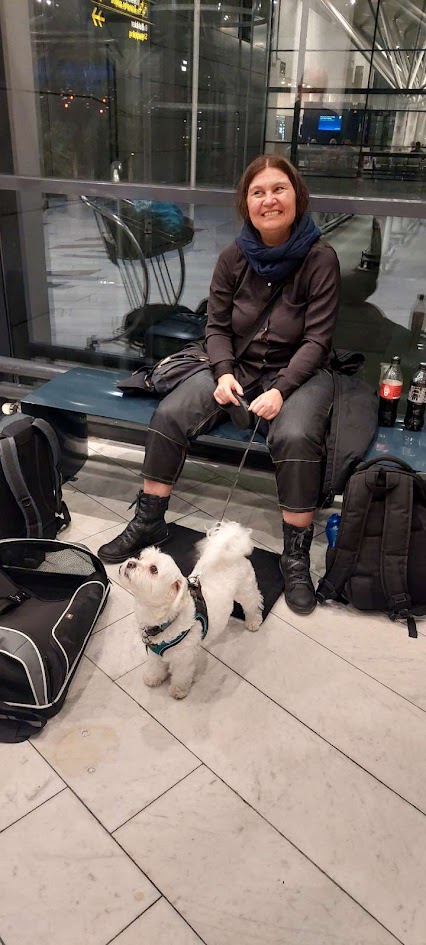
    Sofus the dog in his harness beside a Trixie cabin carrier in the airport terminal.
    Sofus the dog in his harness beside a Trixie cabin carrier in the airport terminal.

    The aircraft-type trap — LOT’s real catch

    LOT’s permitted carrier size isn’t fixed — it depends on the aircraft. Boeing: 55×40×20 cm. Embraer: 45×30×20 cm. And LOT can’t always guarantee which will fly your route on the day.

    This is the thing that makes LOT both better and trickier than its rivals. LOT’s generous Boeing allowance is roomier than SAS (40×25×23 cm) or Norwegian (43×31×20 cm) — but only if a Boeing actually operates your flight. We bought a carrier sized for the larger Boeing dimensions, the Trixie Airline Carrier (55×40×20 cm), knowing it was a calculated bet: if we’d reached the gate and found an Embraer waiting, Sofus’ bag would have been too big and we’d have had a serious problem.

    We checked our specific route, judged a Boeing highly likely, and it paid off. If your dog is close to 6 kg like ours, you face the same calculation — check the aircraft type at booking, monitor it as the date nears, and understand the risk. If your dog is under about 4 kg, the smaller Embraer-sized bag may give enough room to turn around, which is the safe choice.

    The 8 kg rule and the turn-around condition

    The cabin limit is 8 kg combined — dog, carrier and contents. And your dog must be able to stand, turn around and lie down in the carrier; that’s a condition of carriage, not a suggestion.

    A 6.2 kg dog leaves under 1.8 kg for the bag, so you need the lightest carrier that still lets the dog turn around. Measure your dog nose to base of tail and add at least 10 cm for length; measure shoulder height standing and add at least 8 cm for height — before you buy anything. The turn-around rule is the one most websites bury, and it’s exactly what gets dogs turned away at the gate. Sofus once flew at around 7.5 kg years earlier; on our vet’s advice he reached a healthy 6.2 kg, and at the heavier weight we simply could not have flown with him at all.

    Check-in: the LOT desk, in person, 2.5 hours early

    You cannot check in online with a cabin dog. Go to the LOT desk in person and arrive at least 2.5 hours before departure with your EU pet passport and carrier specifications.

    LOT’s online check-in (opened 72 hours ahead) isn’t available to you. At the desk, the agent weighed the carrier on the desk scales, needed to see Sofus inside the bag, then out of it, and completed a form covering the animal’s details, the carrier, and a declaration that he met cabin requirements. The agent was friendly and clearly used to it — but it’s a real check, not a formality.

    Security: the dog comes out, the bag goes through

    The carrier goes through the X-ray belt like any bag; you carry the dog through the metal-detector arch in your arms, then return him to the carrier.

    A detail that changed our whole morning: at Copenhagen, between check-in and the gate, Sofus was allowed to walk on his leash through the departures hall. We can’t promise every airport does this, but it let him investigate, settle, and burn off nervous energy before being enclosed. Use a harness rather than a collar in the crowd.

    On board: the seat restriction nobody mentions

    LOT restricts dog passengers to specific seats — in our case a window seat — and the carrier goes under the seat in front of that passenger.

    Whoever takes the dog’s seat is responsible for the carrier beneath them. With three adults we put our most practically capable person on the aisle to manage boarding and bags, and the dog’s handler at the window. Study the seat map carefully and book toward the front for a shorter boarding walk (we misread it and booked toward the rear — a longer walk than we wanted). Keep moving when boarding, get the carrier stowed with the mesh panel facing outward, then sort everything else. Sofus settled almost immediately and slept through most of the two-hour flight.

     Karen seated in the cabin of a LOT Polish Airlines flight, travelling with a dog.
    Karen seated in the cabin of a LOT Polish Airlines flight, travelling with a dog.

    The descent — the part nobody warns you about

    About 20 minutes before landing, barometric pressure can distress a dog. Bring calming chews and give them roughly an hour before boarding.

    Sofus was quiet the whole flight until descent, when he became agitated and pushed at the base of the bag — something we’d never seen before or since. The likely cause is the pressure change a dog can’t understand or relieve; what looks like bad behaviour is almost certainly physical discomfort. We comforted him through it, and the moment we were off the aircraft we found a quiet corner, opened the carrier and gave him water. He drank, wagged his tail, and was completely fine.

    Should you sedate a dog to fly?

    Veterinary bodies generally advise against sedation for flying. For a short flight, calm comforting often does more — and a sedated dog can’t reposition itself or cope with altitude changes safely.

    We considered it because Sofus is anxious, and decided against — putting him through a brand-new drug at the same moment as a brand-new flight felt like the wrong gamble, and that lined up with the professional consensus. For severe anxiety, ask your vet about mild anxiety relief (not sedation), and test anything at home well before the trip. Calming chews are a comfort aid, not a sedative.

    Is the train the better choice?

    If your dog is over roughly 6 kg, trains are the calmer option — no weight limit for small dogs in carriers, no forms, no carrying a dog through security.

    We flew out to Warsaw and chose trains for the journey home, precisely because of how anxious the weight question had made us. No calculations, no forms — just seats, scenery, and a dog on the floor between us.

    FAQ

    What is LOT’s carrier size limit for a dog in the cabin?

    It depends on the aircraft: 55×40×20 cm on a Boeing B787/B737, but only 45×30×20 cm on an Embraer. LOT can’t always confirm which will operate your flight, so size for the aircraft you expect and monitor your booking.

    What is LOT’s weight limit for a cabin dog?

    8 kg combined — dog, carrier and contents. A 6.2 kg dog plus a light carrier sits near the top of that.

    Can I check in online when flying a dog on LOT?

    No. You must check in at the LOT desk in person; arrive at least 2.5 hours early with your pet passport and carrier details.

    Does the dog go through the airport X-ray?

    No. The empty carrier goes through the X-ray belt; you carry the dog through the metal-detector arch, then return him to the carrier.

    Should I sedate my dog for the flight?

    Vets generally advise against it. For a short flight, comforting usually works better. For severe anxiety, ask your vet about mild anxiety relief — not sedation — and test it at home first.

    This is one leg. The full guide covers the whole journey — five train operators, three cities, the carrier bags we got wrong, the costs, and everything else we learned. €19, instant PDF plus a phone-friendly online version

    This is one leg. The full guide covers the whole journey — five train operators, three cities, the carrier bags we got wrong, the costs, and everything else we learned. €19, instant PDF plus a phone-friendly online version.
    Get the guide — €19

    Karen Svold Coates, author of EuroDogTravels

    Karen Svold Coates — M.Sc. Biology (Aarhus University), professional linguist with 11+ years in localization QA.

    Karen, Carl and Daniel travel Europe by train with Sofus, their 6.2 kg Coton de Tuléar, and document every route firsthand. Every rule on this page was verified in person in spring 2026. This is our experience, not veterinary or airline advice — always confirm current rules with LOT before you fly. Found something that’s changed? Tell us and we’ll fix it.