By Karen Svold Coates, M.Sc. Biology · Verified in person, spring 2026 · Last updated June 2026
Flying With a Dog in the Cabin on LOT Polish Airlines: the Aircraft-Type Trap, the 8 kg Rule & What It’s Really Like (Tested 2026)
Flying a dog on LOT Polish Airlines is possible if the combined weight of dog, carrier and contents is 8 kg or under — but the carrier size you’re allowed depends entirely on which aircraft operates your flight, and LOT can’t always tell you in advance. On a Boeing B787 or B737 the limit is 55×40×20 cm; on an Embraer it drops to 45×30×20 cm.
We flew Copenhagen–Warsaw in spring 2026 with Sofus, our 6.2 kg Coton de Tuléar, and that aircraft-type gamble was the single hardest decision of the trip. Below: how the carrier trap works, exactly what happens at check-in and security, the seat restriction nobody mentions, and the descent that caught us off guard.
The aircraft-type trap — LOT’s real catch
LOT’s permitted carrier size isn’t fixed — it depends on the aircraft. Boeing: 55×40×20 cm. Embraer: 45×30×20 cm. And LOT can’t always guarantee which will fly your route on the day.
This is the thing that makes LOT both better and trickier than its rivals. LOT’s generous Boeing allowance is roomier than SAS (40×25×23 cm) or Norwegian (43×31×20 cm) — but only if a Boeing actually operates your flight. We bought a carrier sized for the larger Boeing dimensions, the Trixie Airline Carrier (55×40×20 cm), knowing it was a calculated bet: if we’d reached the gate and found an Embraer waiting, Sofus’ bag would have been too big and we’d have had a serious problem.
We checked our specific route, judged a Boeing highly likely, and it paid off. If your dog is close to 6 kg like ours, you face the same calculation — check the aircraft type at booking, monitor it as the date nears, and understand the risk. If your dog is under about 4 kg, the smaller Embraer-sized bag may give enough room to turn around, which is the safe choice.
The 8 kg rule and the turn-around condition
The cabin limit is 8 kg combined — dog, carrier and contents. And your dog must be able to stand, turn around and lie down in the carrier; that’s a condition of carriage, not a suggestion.
A 6.2 kg dog leaves under 1.8 kg for the bag, so you need the lightest carrier that still lets the dog turn around. Measure your dog nose to base of tail and add at least 10 cm for length; measure shoulder height standing and add at least 8 cm for height — before you buy anything. The turn-around rule is the one most websites bury, and it’s exactly what gets dogs turned away at the gate. Sofus once flew at around 7.5 kg years earlier; on our vet’s advice he reached a healthy 6.2 kg, and at the heavier weight we simply could not have flown with him at all.
Check-in: the LOT desk, in person, 2.5 hours early
You cannot check in online with a cabin dog. Go to the LOT desk in person and arrive at least 2.5 hours before departure with your EU pet passport and carrier specifications.
LOT’s online check-in (opened 72 hours ahead) isn’t available to you. At the desk, the agent weighed the carrier on the desk scales, needed to see Sofus inside the bag, then out of it, and completed a form covering the animal’s details, the carrier, and a declaration that he met cabin requirements. The agent was friendly and clearly used to it — but it’s a real check, not a formality.
Security: the dog comes out, the bag goes through
The carrier goes through the X-ray belt like any bag; you carry the dog through the metal-detector arch in your arms, then return him to the carrier.
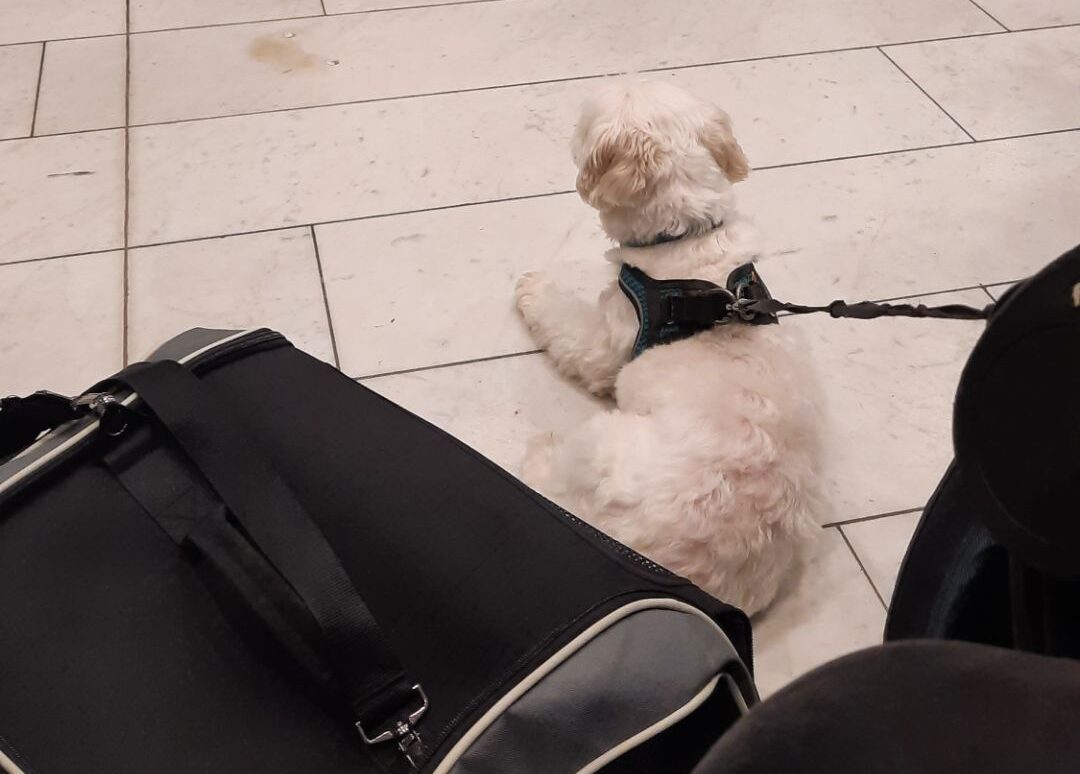
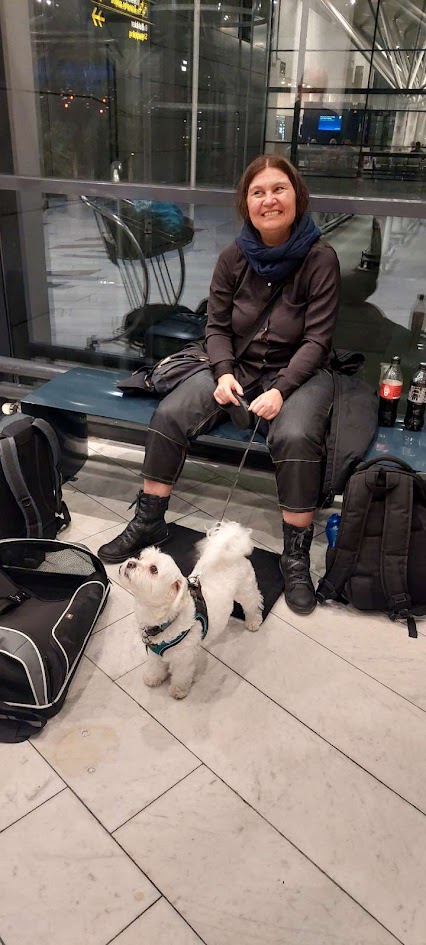
A detail that changed our whole morning: at Copenhagen, between check-in and the gate, Sofus was allowed to walk on his leash through the departures hall. We can’t promise every airport does this, but it let him investigate, settle, and burn off nervous energy before being enclosed. Use a harness rather than a collar in the crowd.
On board: the seat restriction nobody mentions
LOT restricts dog passengers to specific seats — in our case a window seat — and the carrier goes under the seat in front of that passenger.
Whoever takes the dog’s seat is responsible for the carrier beneath them. With three adults we put our most practically capable person on the aisle to manage boarding and bags, and the dog’s handler at the window. Study the seat map carefully and book toward the front for a shorter boarding walk (we misread it and booked toward the rear — a longer walk than we wanted). Keep moving when boarding, get the carrier stowed with the mesh panel facing outward, then sort everything else. Sofus settled almost immediately and slept through most of the two-hour flight.
The descent — the part nobody warns you about
About 20 minutes before landing, barometric pressure can distress a dog. Bring calming chews and give them roughly an hour before boarding.
Sofus was quiet the whole flight until descent, when he became agitated and pushed at the base of the bag — something we’d never seen before or since. The likely cause is the pressure change a dog can’t understand or relieve; what looks like bad behaviour is almost certainly physical discomfort. We comforted him through it, and the moment we were off the aircraft we found a quiet corner, opened the carrier and gave him water. He drank, wagged his tail, and was completely fine.
Should you sedate a dog to fly?
Veterinary bodies generally advise against sedation for flying. For a short flight, calm comforting often does more — and a sedated dog can’t reposition itself or cope with altitude changes safely.
We considered it because Sofus is anxious, and decided against — putting him through a brand-new drug at the same moment as a brand-new flight felt like the wrong gamble, and that lined up with the professional consensus. For severe anxiety, ask your vet about mild anxiety relief (not sedation), and test anything at home well before the trip. Calming chews are a comfort aid, not a sedative.
Is the train the better choice?
If your dog is over roughly 6 kg, trains are the calmer option — no weight limit for small dogs in carriers, no forms, no carrying a dog through security.
We flew out to Warsaw and chose trains for the journey home, precisely because of how anxious the weight question had made us. No calculations, no forms — just seats, scenery, and a dog on the floor between us.
FAQ
What is LOT’s carrier size limit for a dog in the cabin?
It depends on the aircraft: 55×40×20 cm on a Boeing B787/B737, but only 45×30×20 cm on an Embraer. LOT can’t always confirm which will operate your flight, so size for the aircraft you expect and monitor your booking.
What is LOT’s weight limit for a cabin dog?
8 kg combined — dog, carrier and contents. A 6.2 kg dog plus a light carrier sits near the top of that.
Can I check in online when flying a dog on LOT?
No. You must check in at the LOT desk in person; arrive at least 2.5 hours early with your pet passport and carrier details.
Does the dog go through the airport X-ray?
No. The empty carrier goes through the X-ray belt; you carry the dog through the metal-detector arch, then return him to the carrier.
Should I sedate my dog for the flight?
Vets generally advise against it. For a short flight, comforting usually works better. For severe anxiety, ask your vet about mild anxiety relief — not sedation — and test it at home first.
This is one leg. The full guide covers the whole journey — five train operators, three cities, the carrier bags we got wrong, the costs, and everything else we learned. €19, instant PDF plus a phone-friendly online version
This is one leg. The full guide covers the whole journey — five train operators, three cities, the carrier bags we got wrong, the costs, and everything else we learned. €19, instant PDF plus a phone-friendly online version.