By Karen Svold Coates, M.Sc. Biology · Verified in person, spring 2026 · Last updated July 2026
How Does a Dog Go to the Toilet on a Long Train Journey? Two Months, Six-Hour Legs, Zero Accidents (Tested 2026)
A house-trained dog usually does not need to relieve itself on a train, even for five or six hours, because it reads the carriage as an indoor space — a home — and a dog that is properly toilet-trained does not toilet indoors. The trick is not teaching your dog to “hold it” for hours; it is planning the day so it never has to. We traveled two months across Poland and Germany with Sofus, our 6.2 kg Coton de Tuléar, on legs of up to six hours, and he had not a single accident. Below: the one principle that makes it work, the morning routine, what to do about water, and the honest exception nobody warns you about — stations are harder than trains.
This was the worry that kept us up before we left, and it turned out to be almost a non-issue. Here is the full picture.
Do dogs need to pee on a long train journey?
Most house-trained dogs don’t toilet on a train at all, even over five or six hours — they read the enclosed carriage as indoor space, like your living room, where they simply don’t go.
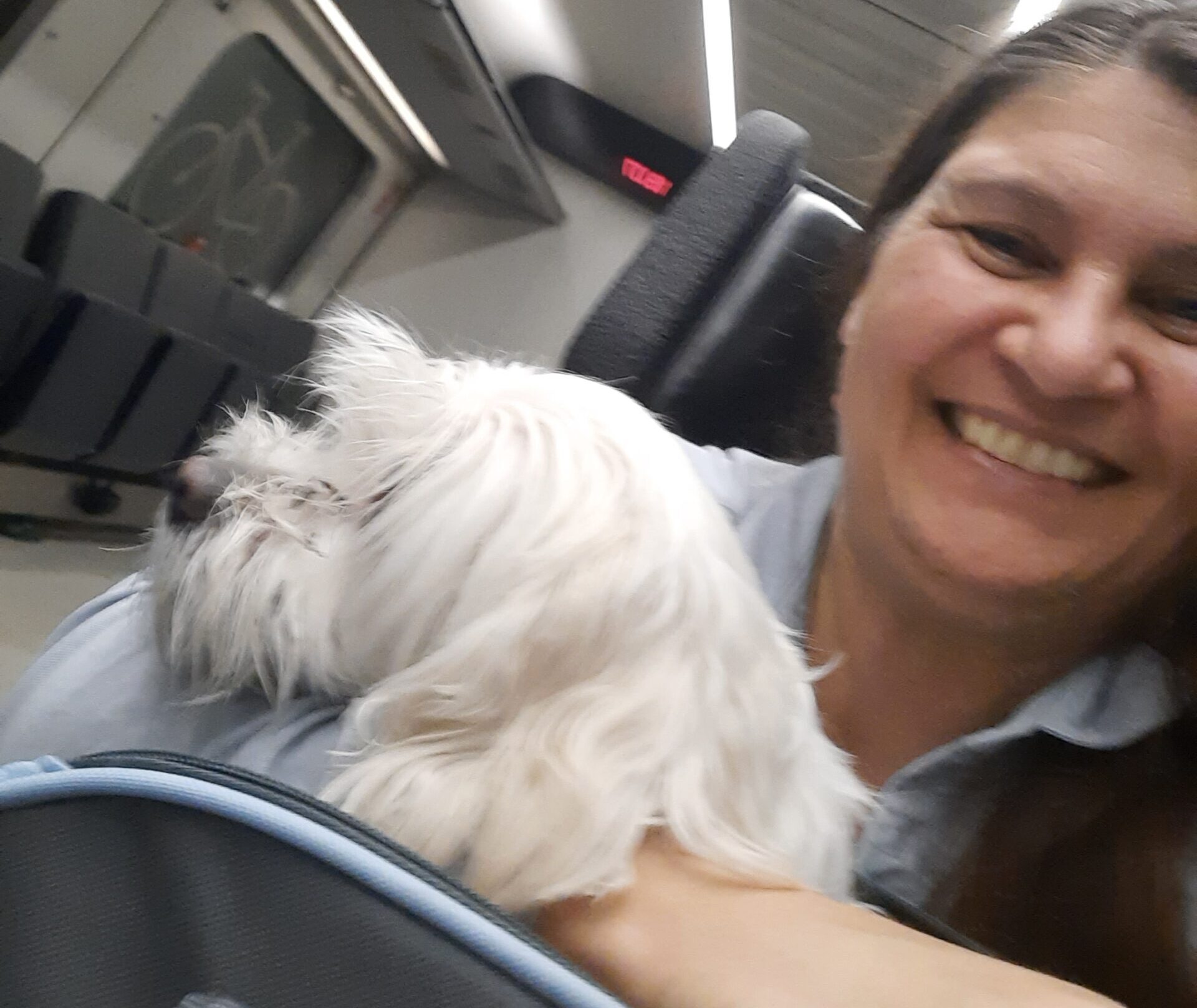
This is the single most reassuring thing we learned, and it reframes the whole fear. When you imagine your dog on a six-hour train, you picture it desperate and suffering the entire time. That isn’t what happens with a potty-trained dog. Sofus wasn’t gritting his teeth and holding it — he genuinely didn’t register the train as a place to wee. He settled, he slept, and the question of the toilet quietly disappeared. The one honest caveat: this depends on your dog being genuinely house-trained — having learned that wee and poo are outdoor-only things. That’s the foundation the whole thing rests on; it isn’t something you can install the week before you travel.
The one rule that makes it work: a five-hour ceiling
Plan every travel day around a rough five-hour ceiling. Where a single leg runs longer, find the toilet break inside it — a connection, a long scheduled stop, or the gap before boarding.
That planning is the real answer to the toilet question — not your dog’s bladder, but your timetable. A few examples from our actual trip:
- Before the flight from Copenhagen, we gave Sofus ten to fifteen minutes on the grass outside the terminal — not a proper walk, just enough time to wee several times before a couple of hours in the cabin.
- The ComfortJet from Berlin to Odense was about six hours inside the train, and it was completely fine — the “home” principle carried it. As it happened, the train stood still in Hamburg for a full hour in those early weeks, and Carl simply took Sofus off for a wee halfway through the longest train day of the trip. (That long Hamburg stop was a temporary diversion; check the current timetable, because it may be gone.)
- On the way home we had about an hour in Odense before the last Danish trains — one built-in break that made a crowded evening leg effortless.
Read your route the same way, and treat the natural pauses as your toilet stops rather than the stations themselves. We planned every one of these breaks in advance; the full day-by-day timetable, with the exact legs and their durations, is laid out in our guide.
The morning routine before a travel day
Start every travel day with a long walk and make sure your dog has actually pooped before you leave. A dog that has emptied out boards the train with nothing pressing.
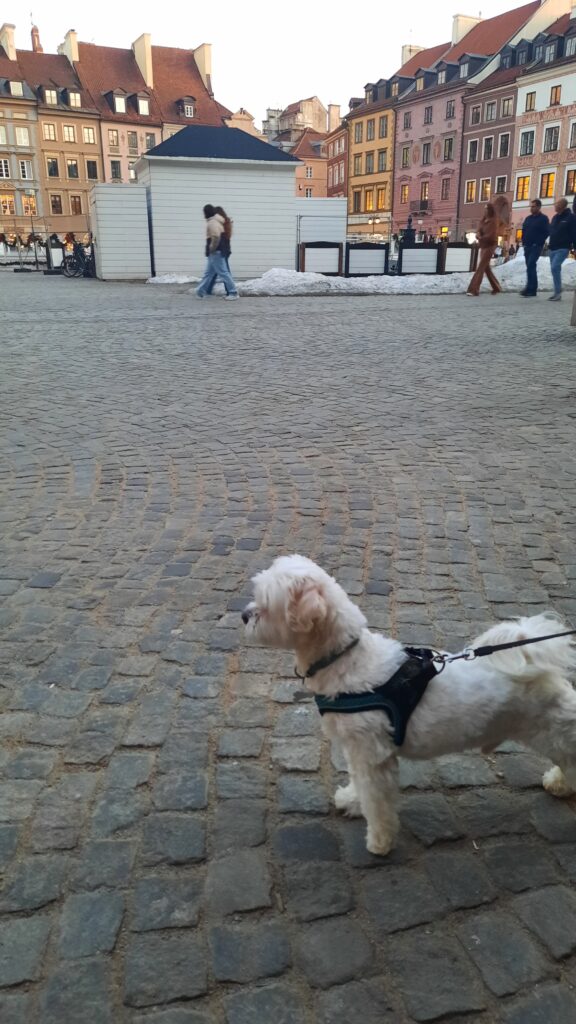
This is the half of the routine first-timers forget, and it’s the half that matters most. Sofus is regular — he poos morning and evening most days — so we planned the hard travel around his rhythm rather than fighting it. Know your own dog’s rhythm and schedule the difficult legs around it; a dog that usually goes at 8am should not be sealed into a carrier at 7:30.
Water: what to do before boarding
Limit water in the hour or two before a long leg — not to the point of thirst, just enough that nothing is urgent — then offer it freely once you’re settled. A lighter stomach also helps with motion sickness.
There’s a related reason to go easy on the stomach before travel, and it isn’t about the toilet: dogs get motion sickness much as people do. After Sofus was sick exactly once — on the PKP Intercity leg, with a well-dressed stranger diplomatically pretending to sleep — we learned to limit his food in the hours before a long train or a flight. If your dog is genuinely prone to travel sickness, ask your vet before you go about anti-nausea options made for dogs.
The honest exception: stations are harder than trains
Stations, not trains, are the tricky part. A big terminal is indoors but full of pillars and walls that look like lampposts — keep your dog moving and away from them.
A big station is a confusing in-between for a dog: indoors, but vast, public, and full of vertical things that look exactly like the lampposts it’s allowed to use outside. Sofus read columns and walls in the big Polish and German stations as fair game, and had to be steered away more than once. So the practical rule is the opposite of what you’d expect: relax on the train, stay alert in the station. And a point of etiquette that’s also the law in much of the EU — don’t let your dog wee on the platform or against station lampposts. It’s frowned upon and, in some places, finable. If your dog needs to go and you’re between the station and the train, get it to a proper patch of grass outside first.
What about puppies and dogs that aren’t fully trained?
For a puppy or a dog still in training, use puppy pads or a travel diaper. The “train is a home” principle only works once the outdoor-only lesson is solid.
There’s no shame in the fallback. For a puppy, bring a supply of pads, offer one during any long stationary stretch, and accept that early trips are practice. For a dog mid-training, a well-fitted travel diaper takes the anxiety out of a long leg entirely. Use these as the safety net that lets you travel now, while the training catches up.
How the toilet worked on our longest legs (verified spring 2026)
Over legs of up to six hours, our dog never had a single accident. Here is exactly how each of our longest journeys was handled.
| Leg | Approx. duration | Toilet break available? | What we did | How it went |
|---|---|---|---|---|
| Copenhagen Airport → Warsaw (LOT, cabin) | ~2 hrs door-to-seat + flight | Yes, before boarding | 10–15 min on grass outside the terminal to wee | No issue |
| Warsaw → Kraków (RegioJet) | ~3 hrs, non-stop | No — no station break at all | Limited water beforehand, long walk before entering the station | No issue |
| Berlin → Odense (ComfortJet) | ~6 hrs, inside the train | Unplanned 1-hr Hamburg stop | Used the Hamburg stop for a wee; otherwise the “home” principle held | No issue |
| Odense → home (DSB) | Short final legs | Yes — ~1 hr in Odense | Full walk and wee in Odense before the last trains | No issue |
FAQ
How long can a dog hold its bladder on a train?
A healthy adult dog can comfortably go five to six hours without a toilet break, and a house-trained dog on a train usually doesn’t feel the need to go at all, because it reads the carriage as indoor space. Plan a break roughly every five hours anyway, and you’ll never test the limit.
Will my dog have an accident on the train?
A properly house-trained dog is very unlikely to toilet on a train — it treats the carriage like your living room. Over two months and legs of up to six hours, our dog never once did. Puppies and dogs still in training are the exception; use puppy pads or a travel diaper for them.
Should I give my dog water on a long train journey?
Limit water in the hour or two before a long leg so there’s nothing urgent to pass, then offer it freely once you’re settled. Keeping the stomach light before travel also helps with motion sickness.
How do I get my dog to the toilet during a journey with no stops?
Build the break into your plan rather than the train: use connections, long scheduled stops, and the gap before boarding. A thorough morning walk — making sure your dog has pooped before you leave — is what makes a stopless leg like a non-stop three-hour train painless.
Can my dog pee on the station platform?
No — weeing on platforms and station lampposts is frowned upon and finable in much of the EU. Stations are also where dogs are most tempted, since pillars and walls look like lampposts, so keep your dog moving and take it to grass outside if it needs to go.
This is one worry, answered. The full guide covers the whole journey — five train operators, three cities, one cabin flight, the carrier bags we got wrong, the costs, and everything else we learned. €19, instant PDF plus a phone-friendly online version.